Select a site alphabetically from the choices shown in the box below. Alternatively, browse sculptural examples using the Forward/Back buttons.
Chapters for this volume, along with copies of original in-text images, are available here.


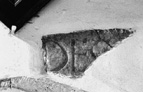
Object type: Inscription [1]
Measurements: H. c. 20 cm (8 in); W. (max.) 54 cm (21.25 in); D. Built in
Stone type: Inaccessible, but colour appears to be greenish; Possibly Upper Greensand, Gault Group, Lower Cretaceous
Plate numbers in printed volume: Ill. 431
Corpus volume reference: Vol 4 p. 255
(There may be more views or larger images available for this item. Click on the thumbnail image to view.)
The stone is sub-rectangular; the upper and left-hand edges are roughly squared and the broken lower edge slopes slightly downwards. The roughly broken right-hand edge slopes up to the right, cutting off the lower part of the last letter of the (slightly deteriorated) inscription.
Inscription The letters (Okasha 1971, 56), which are boldly cut, seem to be c. 20 cm (8 in) high, that is, a little larger than those of Breamore, Ha. (St Mary) no. 2c. They are capitals, and read:
--DE[S]--
The two complete letters, and probably also the fragmentary S, are of the standard Roman capital form. The language and meaning of this fragment are uncertain.
This piece is clearly ex situ and is normally assumed to have been a voussoir (or part of one) from an arch-head similar to that opening into the south porticus (see Breamore no. 2). It may be from the destroyed pre-Conquest chancel arch or north porticus arch. The shape of the stone provides no supporting evidence for this hypothesis; only the upper edge may be original, but this is partially overlain by later plaster and it is not clear if its slight curvature is an original feature or the result of reuse. Whether or not the letters are arranged in a straight line or on a slight curve is impossible to ascertain without photography or drawing in the same plane as the stone. The fragment presumably reached its present position when the chancel arch was rebuilt in the fifteenth century, and it was used to patch the wall above the newly inserted arch head.
Inscription The style of cutting and letter forms are similar to those on Breamore no. 2c. The letters seem, however, to have been a little taller and to have had rather more definite serifs than on the latter. The forms are not diagnostic enough for dating, but there is no reason why this lettering should not be contemporary with that of no. 2c.
