Select a site alphabetically from the choices shown in the box below. Alternatively, browse sculptural examples using the Forward/Back buttons.
Chapters for this volume, along with copies of original in-text images, are available here.


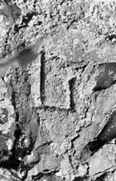
Object type: Inscription
Measurements: H. 9 cm (3.5 in); W. 14 cm (5.5 in); D. Built in
Stone type: Very pale orange, medium- to coarse-grained, oolitic limestone; Combe Down Oolite, Great Oolite Formation of the Bath area, Great Oolite Group, Middle Jurassic
Plate numbers in printed volume: Ill. 432
Corpus volume reference: Vol 4 p. 256
(There may be more views or larger images available for this item. Click on the thumbnail image to view.)
Inscription What seems to be the lower part of a letter, almost certainly a square version of capital G (Okasha 1983, 88), remains, and is set sideways with its left side to the ground:
--[G]--
Like the chancel arch the west wall of the church is a fifteenth-century rebuild. It appears that parts of a pre-Conquest inscription, possibly from the original chancel arch, or north porticus arch were reused as building material in these operations.
Inscription Square G of this sort could easily be contemporary with Breamore no. 2, and is in fact used on the modern insert in no. 2 which may well preserve the original letter forms (see no. 2). The deep cutting and the slightly expanded terminal are comparable to those of no. 2c. The surviving height of the letter is about 9 cm (3.5 in) so it is of a large format similar to that of Breamore nos. 2c and 3. The stone type has been identified as being the same as that used for the imposts (nos. 2a–b) of the arch that opens to the southern porticus (but not for the voussoirs which carry the inscription, no. 2c). It is likely that this inscription came from another architectural inscription contemporary with no. 2c.
