Select a site alphabetically from the choices shown in the box below. Alternatively, browse sculptural examples using the Forward/Back buttons.
Chapters for this volume, along with copies of original in-text images, are available here.


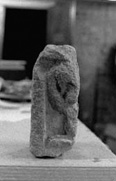
Object type: Two fragments of cross-shaft
Measurements: a: H. 35 cm (13.8 in); W. 24 cm (9.5 in); D. 12 cm (4.7 in) b: H. 22 cm (8.7 in); W. 14 cm (5.5 in); D. 7 cm (2.8 in)
Stone type: Pale greyish-yellow, medium-grained, slightly shelly, oolitic limestone with calcite veinlets; Combe Down Oolite, Great Oolite Formation of the Bath area, Great Oolite Group, Middle Jurassic
Plate numbers in printed volume: Ills. 457-64
Corpus volume reference: Vol 4 p. 264-265
(There may be more views or larger images available for this item. Click on the thumbnail image to view.)
Fragment a is part of a tapering shaft of square section trimmed flat above and below, but otherwise roughly broken so that only small parts of faces A and D survive. Face A has the lower and left-hand edges undamaged. The upper edge is horizontally trimmed and the right-hand edge is roughly broken, and slopes inwards towards the upper edge.
A (broad): Along the lower and left-hand edges is a border comprising a plain relief outer moulding inside which, to the left, is a second similar moulding with a double-stepped base. The face is divided into two roughly equal fields by a horizontal relief moulding whose rounded end protrudes into the inner moulding to the left, and is separated from it by an incised line, paralleled by a second similar line. Half-way along its length the moulding is double-stepped, reducing its width by two-thirds. On the narrow portion stands a double-stepped base supporting a stem terminating in a narrow suppedaneum which is wider than the stem. Standing on this is the out-turned right foot of a robed figure, most of which is lost. To the left a portion of the robe falls in three vertical folds of diminishing size to touch the moulding. Below the horizontal moulding are two naturalistically-modelled animals facing right, and crouched on the lower frame, that to the right partially overlapping the other; one appears to be leonine, the other may be a sheep.
B (narrow): Destroyed.
C (broad): The original face is entirely destroyed. There is a vertical half-round channel, with a second similar channel sloping up from it to the broken left-hand edge of face D.
D (narrow): Only a marginal fragment remains, having a broad plain border below, and a plain double moulded one to the right. From this develop four upward-pointing, expanding, rounded-ended leaves, placed one above the other.
Fragment b is part of the same tapering shaft of square section as fragment a. Only a small part of faces A and B survive; the rest is roughly broken away. On face A the upper and left-hand edges are roughly broken.
A (broad): Below and to the right is a narrow plain relief border, with a damaged upward-pointing, expanding, rounded-ended leaf developing from the upper border to the right. The face is decorated with a nimbed eagle facing to the right, its surviving wing outspread and the feathers indicated by incised lines. In its talons the eagle holds a closed book.
B (narrow): Only a marginal fragment survives, having a narrow plain border below and to the left. The surviving portion of the face is decorated with what appears to be an animal facing left and lying on the lower border.
Since they are of the same material, decorated in the same sculptural technique, and with similar types of decoration, it seems likely that the two pieces derive from the same shaft, although they do not join.
As noted above (Chap. VII), the identification of the scene or scenes on this shaft remains speculative. The figure standing on the T-shaped support could be the crucified Christ, or one of the Evangelists, while the animals below the figure can only be identified as a sheep, and a predator, possibly a lion. The Eagle holding a book on fragment b must, however, be the symbol of St John.
Such stylistic links as can be drawn for the piece, particularly the hard mechanical fold of drapery falling down beside the figure on face A of fragment a, have parallels in mid eleventh-century works, when the flattering draperies of the Winchester style and the characteristic broken profile of the folds had become hardened and more regular. Similar draperies are seen, for example, in Aelfric's Pentateuch (Temple 1976, no. 86, ills. 269–72) and BL MS Cotton Tiberius B. V (ibid., no. 87, ills. 273–6), both works of the second quarter of the eleventh century. The form of the leaves developing from the frames of both fragments also points to a late date, as leaves of this particular form are commonest in metalwork of the Trewhiddle style (see Fig. 24a–d, and Introduction, Chap. VII).
