Select a site alphabetically from the choices shown in the box below. Alternatively, browse sculptural examples using the Forward/Back buttons.
Chapters for this volume, along with copies of original in-text images, are available here.


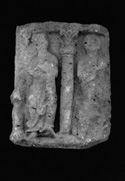
Object type: Part of cross-shaft
Measurements: H. 35 cm (13.8 in); Diameter (reconstructed) c. 46 cm (18 in)
Stone type: Medium light grey, finely granular limestone, with numerous Serpulid worm tubes; Ditrupa limestone, Calcaire Grossier Formation, Palaeogene, Tertiary; Paris Basin
Plate numbers in printed volume: Ills. 108-110
Corpus volume reference: Vol 4 p. 138
(There may be more views or larger images available for this item. Click on the thumbnail image to view.)
Part of a drum of a shaft of circular section, dressed flat above, below, and to each side. Only two faces are carved.
A (side): The surviving portion of the circumference is divided into two equal fields by a three-quarter round column with a damaged base. The damaged capital, separated from the column by a narrow roll moulding, has a pair of outward-facing S-shaped scrolls flanking an upright leaf, from above which springs a pair of scooped volutes linked at the base. Between them is a small, round ended, scooped leaf. Along the left-hand edge of the drum are the mutilated remains of a second similar column. These support a heavily damaged flat entablature, originally of square section, along the upper edge of the drum. In the left-hand field is a heavily damaged, full-length, frontally-placed figure, with its arms held across the body at waist level, and with the feet apart standing on a roughly-indicated ground surface. The figure wears a full-length robe with a folded hem, and an overgarment gathered up from left to right and thrown over the figure's left arm. A similar but more heavily damaged figure occupies the right-hand field.
E (bottom): A two-strand twist runs round the edge (Kozodoy 1976, 90, fig. 31; idem 1986, 76, pl. XXXVIc).
Both figures are clad in Classical dress (the tunica and pallium) and can probably therefore be identified as two of the Apostle or Prophets. It is unusual for a selection of the Apostles, apart from the Evangelists, to be depicted, but a selection of the prophets would be possible, though there is too little evidence for more than speculation.
The most interesting feature of this fragment is the two-strand guilloche on the underside. For this to have been visible, the stone must have been set fairly high up in its original context, and must have projected by nearly 3 cm.
For the probability that this stone originally formed part of the same monument as Reculver 1a–e, and its possible relationship to the other surviving pieces, see Reculver 1a–e, Discussion.
