Select a site alphabetically from the choices shown in the box below. Alternatively, browse sculptural examples using the Forward/Back buttons.
Chapters for this volume, along with copies of original in-text images, are available here.


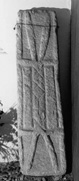
Object type: Grave-cover
Measurements: L. 187 cm (73.6 in); W. 50 cm (19.7 in); D. 26 cm (10.2 in)
Stone type: Brownish-grey, fine- to medium-grained (0.2-mm quartz grains), finely glauconitic sandstone; Hythe Beds, Lower Greensand Group, Lower Cretaceous; Petersfield to Pulborough area
Plate numbers in printed volume: Ill. 250
Corpus volume reference: Vol 4 p. 198
(There may be more views or larger images available for this item. Click on the thumbnail image to view.)
It tapers and is square ended.
A (top): There is a narrow, low-relief border along the long edges. There is a broad, low-relief median band which bifurcates about a third of the way in from each end. Each pair of bifurcations diverges and runs off the end alongside, but not touching, the borders. Towards the upper end of the median moulding is an incised Latin cross from the lower end of which develops a pair of complete incised lozenges, and half of a third, placed one above the other, and spanning the width of the moulding. From the head of the cross develops a similar lozenge and half of a second. At each point of bifurcation one of a pair of expanding relief mouldings runs from each edge of the median band to the edge of the face, crossing the border.
Appendix A item (stones dating from Saxo-Norman overlap period or of uncertain date).
There is no archaeological evidence for the dating of this cover, but the form, with a median ridge bifurcating at either end and with subsidiary cross-bars at the points of bifurcation, can be paralleled among the eleventh-century Sussex covers from Stedham (no. 4; Ill. 241) and Cocking (Ill. 228), and there is a variant form at Chithurst (no. 1; Ill. 220). Reasonably convincing archaeological evidence is available for the dating of the Cocking and Stedham covers. The bifurcating mid-rib employed on these grave-covers may be derived from the mid-ribs with U-shaped ends seen among East Anglian examples of the early to mid eleventh century (Fox 1920–1, pl. III). Covers of this type certainly reached south-east England, as at Milton Bryan (Ill. 361) and Cardington (Ill. 264) in Bedfordshire, and London (St Benet Fink) (Ills. 345–6).
