Select a site alphabetically from the choices shown in the box below. Alternatively, browse sculptural examples using the Forward/Back buttons.
Chapters for this volume, along with copies of original in-text images, are available here.


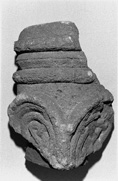
Object type: Part of cross-shaft
Measurements: H. 34 cm (13.4 in); W. 19.7 cm (7.8 in)
Stone type: Greyish-yellow, medium-grained, oolitic limestone, slightly shelly, with calcite veinlets; Combe Down Oolite, Great Oolite Formation of the Bath area, Great Oolite Group, Middle Jurassic
Plate numbers in printed volume: Ills. 20-23
Corpus volume reference: Vol 4 p. 127-128
(There may be more views or larger images available for this item. Click on the thumbnail image to view.)
It is of square section above and circular section below. The fragment is roughly broken above, below, and to the rear, so that parts of only two adjacent faces of the upper portion of the shaft survive. The lower ends of these faces are semicircular, project, and are slightly concave. They are delimited by prominent roll mouldings which merge where the faces abut.
Faces A and B are decorated with interlace, but the decoration is too fragmentary for the patterns to be identified. In each case the strands are median-incised. Below these faces where the shaft assumes a circular section less than a quarter of the circumference survives, enriched with three roll mouldings. The median moulding is recessed and has an incised median line.
Like Canterbury (St Augustine's Abbey) no. 3, it may have been one of the 'smaller fragments' of pre-Conquest sculpture discovered by Hope built into the base of the Romanesque screen overlying Wulfric's rotunda. It is not specifically mentioned by him, however.
For many years this piece was interpreted and displayed as part of a turned baluster shaft with an elaborate base, but comparison with the surviving balusters from Kent throws considerable doubt on this identification. Two of the three turned balusters from St Augustine's Abbey have surviving bases (nos. 6 and 7) and both of these are undecorated, square in plan, and rectangular in section (Ills. 41–3, 46–8); outside Kent there is similarly no evidence for the use of elaborately shaped and decorated baluster bases. In addition, the triple roll moulding on the putative St Augustine's baluster fragment cannot be paralleled elsewhere, either on other balusters from the same site, or on any of the closely-related group from Dover (St Mary in Castro) nos. 2–3 (Ills. 64–7, 71–5). On all of these, where groups of three mouldings do occur, it is the median moulding which is the most prominent, and the pair of mouldings flanking it are recessed and much slighter. In addition, none of the mouldings on the Kent balusters has an incised median line.
Also inconsistent with the use of this piece as a baluster base is the decoration of the two surviving facets. Close examination confirms that neither facet has any surviving vestige of a lower edge moulding, meaning that the fields are incomplete. Their original size is difficult to estimate, but the interlaces filling them are best regarded as the ends of longer patterns. It is possible to construct more compact patterns by simply joining the loose ends of the interlaces, but they are unconvincing and unparalleled elsewhere. If, however, the interlaces are viewed as the ends of longer patterns then the design on face A falls into place as the end of a pattern based on a four-strand plait. The interlace on face B could equally be interpreted as the end of a six-strand plait.
The most elegant solution to these difficulties is simply to invert the fragment, when it can be viewed as part of a round-shaft derivative of the type common in the west midlands, where the upper part of the shaft is of square section and the lower part of circular section. The facets then fall into place as the semicircular swags at the lower ends of two of the faces of the upper part of the shaft, permitting the reconstruction of the interlaces in the most convincing fashion, as the ends of longer patterns. The triple roll moulding can, similarly, be interpreted as the zone of triple roll mouldings normally found encircling such a shaft immediately below the zone of transition between its upper and lower elements. Although the concentration of shafts of this type in the north-west midlands suggests that it is a regional type (Kendrick 1949, 68–76), there are outliers in other regions. These include the example from Gilling West, Yorkshire (Lang, pers. comm.), and a small group, including the Gosforth cross, in Cumbria (Bailey and Cramp 1988, ills. 288–308). A single example, Eiliseg's Pillar, Denbighshire, is known from Wales (Nash-Williams 1950, 123–5, pls. XXXV–VI). Most importantly for the present piece, there is another example from southern England, at Yetminster, Dorset (Kendrick 1949, 72–3). Other round shafts from south-east England may originally have formed part of the base of such a cross, but there is now no way of establishing this.
