Select a site alphabetically from the choices shown in the box below. Alternatively, browse sculptural examples using the Forward/Back buttons.
Chapters for this volume, along with copies of original in-text images, are available here.


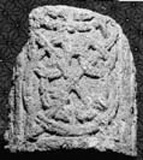
Object type: Part of cross-shaft [1]
Measurements: H. 34 cm (13.4 in); W. 29.5 cm (11.5 in)
Stone type: Pale yellow, medium- to coarse-grained, oolitic limestone, with shell fragments and a calcite veinlet; bedding is parallel to axis of shaft; Combe Down Oolite, Great Oolite Formation of the Bath area, Great Oolite Group, Middle Jurassic
Plate numbers in printed volume: Ills. 474-477
Corpus volume reference: Vol 4 p. 268
(There may be more views or larger images available for this item. Click on the thumbnail image to view.)
The shaft is of circular section, trimmed flat below, but roughly broken above and to the rear. About half the original circumference survives and is occupied by a rectangular field delimited (except on the upper, broken, edge) by plain, raised borders. The field is filled with an encircled pattern C interlace with median-incised strands. Above and to the right are the marginal remains of interlace of the similar pattern.
F (bottom): In the base is a prominent dowel hole.
The presence of a dowel hole in the base suggests that this piece derives from a round shaft built in drums, in the manner of the shaft from Reculver, no. 1. The small diameter of the hole suggests a metal fitting was used to hold the drums together.
This piece must date to the ninth century or later, as it was not until the ninth century that the round shaft was introduced (see Chap. V). However, an even later date is suggested by the use of rather thick, heavy interlace, with median incisions, characteristics usually employed on interlaces of the tenth and eleventh centuries, as on the Bishops Waltham and Wherwell shafts.
