Select a site alphabetically from the choices shown in the box below. Alternatively, browse sculptural examples using the Forward/Back buttons.
Chapters for this volume, along with copies of original in-text images, are available here.


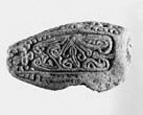
Object type: Trial piece?
Measurements: H. 9 cm (3.5 in); W. 4.8 cm (1.9 in); D. 2.4 cm (0.9 in)
Stone type: Pale grey, finely glauconitic, fine-grained sandstone; probably a Thanet Beds sandstone from Reculver or Pegwell Bay, Kent; Palaeogene; Tertiary
Plate numbers in printed volume: Ills. 54-56
Corpus volume reference: Vol 4 p. 134-135
(There may be more views or larger images available for this item. Click on the thumbnail image to view.)
It is sub-triangular with the upper edge convex. The lower and left-hand edges are roughly broken. It is of sub-triangular section, tapering towards the lower edge.
A (broad): Along the upper edge is a row of pellets. Below this is a row of three rosettes, each with hollowed petals and encircled by a plain moulding. The central encircled rosette is set under an arch composed of a median-incised moulding. Similar half arches to the left and right enclose the flanking rosettes, which are separated by the common piers. To the left and right the arch head develops into a row of pellets encircling the underside of the rosette. A similar row of pellets, but here confined between the plain mouldings, links the bases of the piers curving below the central rosette.
C (broad): There is a row of pellets on the upper edge separated by a plain zone by a sub-rectangular field. This is filled with median-incised interlocking spiraliform elements, one pelleted. To the left is a quadrilobate element, with the lobes hollowed. A row of beading edges this end of the decorative field. Another row of pellets develops from the left to flank the lower edge of the field for a short distance.
The function of this piece is very uncertain, but the fact that the carving partially overlies some of the broken edges suggests that it is not part of a larger object. Cramp has suggested that the may be either a mould or a trial piece (Cramp 1975, 191). It is, however, extremely unlikely that it could have been used as a mould. The design is too shallow to trap any molten metal, if it were used as a one-piece mould. Nor, if it were part of a two-piece mould, is there any method for engaging the two halves. There is also none of the characteristic discolouration which might be expected from heating. The shallowness of the carving also rules out the use of the piece as a matrix.
It seems much more likely that the piece is a trial or motif-piece. The small scale of the fragment, the lack of detailed finishing of the piece, and the unintegrated nature of the decoration, are all characteristic of such pieces, which can be regarded as sketches for works in other materials, or training exercises (O'Meadhra 1987, 169–70). Trial pieces are not common in England, but have been encountered in a variety of materials in major urban excavations, most notably in London (for example, Wheeler 1935, pl. XXI), and York (for example, Hall 1984, figs. 56–7); the majority date from the ninth to tenth centuries.
It is, however, possible that the piece was used directly to emboss leather. It is shaped like the tip of a scramasax sheath, and has the correct cross-section. It could have been inserted into the tip of a pre-formed sheath through the open seam. The wet leather would then have been pressed over the pattern, embossing it into the leather. Pre-Conquest leather sheaths are relatively uncommon but all were designed to house the blade and handle of the knife, with the decoration on the sheath reflecting this division (Tweddle 1986a, 237–41, fig. 107, pls. XI–XIII). This piece would yield the pattern covering the area housing the blade.
The use of rosettes, of a hybrid ornament combining seed pods, foliate elements, and spirals, and of pelleting, all point to an early ninth-century date.
