Select a site alphabetically from the choices shown in the box below. Alternatively, browse sculptural examples using the Forward/Back buttons.
Chapters for this volume, along with copies of original in-text images, are available here.


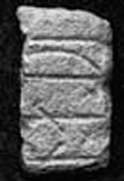
Object type: Inscription (cast)
Measurements: H. 6.5 cm (2.6 in); W. 12 cm (4.7 in); D. 2.2 cm (0.9 in)
Stone type: Not identifiable from the cast
Plate numbers in printed volume: Ill. 58
Corpus volume reference: Vol 4 p. 135
(There may be more views or larger images available for this item. Click on the thumbnail image to view.)
Inscription The cast shows four runic characters that appear to be Scandinavian. Irrespective of whether * and # are left-facing — as the presence of retrograde u suggests they may be — the occurrence of both forms makes it unlikely that the runes are Anglo-Saxon. The fact that u is retrograde poses problems for the reading of the inscription: what is the direction of writing, and which of * # is a and which n? There are four possible readings.
(right to left): (i) anu[.] or (ii) nau[.]
(left to right): (iii) [.]uan or (iv) [.]una
Of these (i), in which we have a straightforward right-to-left inscription, is the most plausible, followed by (iii), where it is assumed that the second rune is retrograde but that the third and fourth face the same way as the direction of writing. The other two readings are considerably less probable.
A note on the back of the cast in R. A. Smith's handwriting reads 'St. Augustine's Canterbury (Rev. F. J. Badcock)'. A second cast in the British Museum is marked 'St. Augustine's College'. Badcock was a member of the College in the early part of this century. The phraseology leaves it unclear whether the original of this fragment came from St Augustine's, or whether he had taken a cast of something that he had seen elsewhere. However, nothing resembling this cast is now known.
Inscription The problems involved in reading the inscription, together with its seemingly fragmentary state, make interpretation well-nigh impossible. anu does not give a known word, but if we assume the sequence to contain the remnants of more than one word, -a nú or -ann u- are two of the more likely among several possibilities. uan, might be the first or third person past singular of vinna ('work', 'achieve', 'overcome'). In the absence of further clues, however, such speculation is fruitless.
