Select a site alphabetically from the choices shown in the box below. Alternatively, browse sculptural examples using the Forward/Back buttons.
Chapters for this volume, along with copies of original in-text images, are available here.


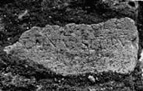
Object type: Inscribed stone
Measurements: H. 10 cm (4 in); W. 23 cm (9 in); D. c. 5 cm (2 in)
Stone type: Pale yellow, medium- to coarse-grained, granular or pellety limestone; Marquise stone of a yellowish, even-grained facies, Oolithe de Marquise Formation, Bathonian, Middle Jurassic; Boulonnais, France
Plate numbers in printed volume: Ill. 57
Corpus volume reference: Vol 4 p. 136-137
(There may be more views or larger images available for this item. Click on the thumbnail image to view.)
Inscription The fragment (Okasha 1971, 60–1) is almost certainly reset in its present position. The stone is finely dressed and the lettering neatly incised. The lettering is set horizontally and the right way up for reading, but none of the original edges of the inscribed face now seems to survive. Parts of two lines of worn lettering remain. In the upper line the upper parts of the letters have broken away. The lower line was probably the bottom line of the text, since the space beneath is much larger than that between the two existing lines. It is not certain how many, if any, are lost above the two that remain; nor is it clear how much of the stone and of the text is lost on the left and right sides. The letters are comparatively small: about 1.8 cm (0.7 in) high. The inscription is in capitals and reads:
--[.ORE SCE]--
--[.] OMNIV SCORV--
The language is Latin and the expansion of the last two words is certain: OMNIV(M) S(AN)C(T)ORV(M), which can be translated as 'of all the saints' or 'of All Saints'. What remains of the letters in the line above is compatible with the letters --ORE SCE. In the context and with a following genitive, the first partially surviving word, which probably ended in --ORE, should probably be reconstructed as [HON]ORE. We would then have the common dedicatory formula: in honore(m) with the genitive (Higgitt 1979, 368–70). The next three letters, if correctly read as SCE, are probably another abbreviation of sanctus, in this case the genitive of the feminine singular: S(AN)C(T)E. The text could then be plausibly reconstructed as: ... in honore (or honorem) sancte ... et omnium sanctorum ('... in honour of Saint (or 'the holy') ... and of all the saints').
The letters have suffered in their exposed position, though it can still be seen that they were carefully executed. They appear to have been of even breadth. Slight traces of light serifs seem to survive at the ends of one or two strokes. The letters are capitals. The forms are standard Roman ones, with the following exceptions: square C; M with vertical outer strokes and a short central V. Only eight different letters are represented, and they are given forms that can be found in both early and late Anglo-Saxon inscriptions (Okasha 1968). The letter forms do not, therefore, help in dating this inscription.
Words are separated by gaps, but there is now no trace of points being used as word-dividers. Bars are used to mark abbreviations in the correct manner. The abbreviations consist of the suspension of final M and the regular contraction of sanctus. (The bar noted by Okasha over the first O of OMNIV is probably an accidental mark (Okasha 1971, 61).)
The piece is dated by its incorporation into the jamb of a doorway which has been dated to 600–50 (Taylor and Taylor 1965–78, i, 143). However, a later dating for this doorway is possible, and even if the doorway dates from the seventh century, it is possible that the piece is a later insertion; the rest of the jambs and archway are largely made from reused Roman brick.
Inscription It is probable that this inscription originally recorded the dedication of a church or an altar. As has already been seen, the present location is probably secondary, and so it is not certain to which church or altar it would have originally referred. The use of the in honore(m) formula does not help to date the text; it is found in both early and late dedication inscriptions (Higgitt 1979, 368–70). While Anglo-Saxon dedication inscriptions could contain several elements, it is possible that this inscription consisted originally of no more than the formula in honore(m) with the names of the dedicatees in the genitive (see the analysis of dedication inscriptions in Higgitt 1979, 367–70). The list of dedicatees probably opens with the feminine singular sancta. This could introduce the name of a female saint or another feminine noun such as trinitatis for the Holy Trinity. The list probably ends with All Saints as does that on the late Anglo-Saxon dedication inscription in St Mary Castlegate in York (Higgitt in Lang 1991, 100). If St Martin's (or any other saint's) name was originally included in the list, it would then have had to appear between the feminine dedicatee and All Saints, which would necessitate relatively long lines. The dedication to All Saints is perhaps an argument against a very early date. It seems not to be recorded as a church dedication in seventh- or eighth-century England, although the feast of All Saints was known in Northumbria after the middle of the eighth century (Levison 1946, 160, 259–65; Binns, Norton and Palliser 1990, 138).
