Select a site alphabetically from the choices shown in the box below. Alternatively, browse sculptural examples using the Forward/Back buttons.
Chapters for this volume, along with copies of original in-text images, are available here.


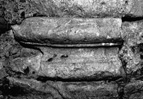
Object type: Column-base
Measurements: H. 42 cm (16.5 in); Diameter 59 cm (23.2 in)
Stone type: Yellowish-grey, finely granular limestone, with Ditrupa; Ditrupa limestone, Calcaire Grossier Formation, Palaeogene, Tertiary; Paris Basin
Plate numbers in printed volume: Ills. 59-60
Corpus volume reference: Vol 4 p. 137
(There may be more views or larger images available for this item. Click on the thumbnail image to view.)
Although this piece has usually been regarded as reused Roman material (Hope 1902, 228; Taylor and Taylor 1965–78, i, 146), Blagg has pointed out that it has several highly unusual features which make this highly improbable. For example, the combination of tall plinths with low roll mouldings is much more typical of fifth- and sixth-century column bases from the eastern Mediterranean, than it is of Romano-British bases. Moreover, these eastern Mediterranean bases also lack a cyma or cavetto moulding above the upper roll, as here (Ill. 59).
More recent excavations at St Pancras's have suggested that the columns supporting the triple arcade were secondary insertions, probably of the late seventh or eighth century, and that the church originally had only a single arch separating the nave from the chancel (Jenkins 1975–6, 4–5). If so, then the columns may have been made at that time, specifically for this location.
