Select a site alphabetically from the choices shown in the box below. Alternatively, browse sculptural examples using the Forward/Back buttons.
Chapters for this volume, along with copies of original in-text images, are available here.


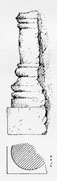
Object type: Parts of four balusters
Measurements: Unobtainable
Stone type: Caen stone' (Scott 1862–3, 6)
Plate numbers in printed volume: Ills. 71-75, 79-80
Corpus volume reference: Vol 4 p. 140-141
(There may be more views or larger images available for this item. Click on the thumbnail image to view.)
The problem of determining which of the fragments drawn by Puckle (Ills. 75, 79–81) are to be identified with those drawn by Baldwin Brown (Ills. 71ndash;4) is discussed stone by stone; the descriptions, however, have been based on Baldwin Brown's drawings, as these seem likelier to be the more accurate.
a: Brown's drawing of fragment a (Ill. 71) probably to be identified with Puckle's shaft 1 (Ill. 79), as the differences between the mouldings in the two drawings are very slight.
On a square base of rectangular section stood the lower half of a turned baluster, broken off roughly above and to the rear. Above the base was a square fillet surmounted by a pair of rolls, the upper of which tapers. This, in turn, was surmounted by a prominent roll, with another, slighter, roll above it. The plain shaft then swelled gently before tapering again towards a roll with a prominent angular roll above it. The rest of the shaft had been lost.
b: The drawing of fragment b in Brown (Ill. 73) is probably to be identified with Puckle's shaft 2 (Ill. 80). There are small differences between the two, notably the absence of the median groove in Puckle's sketch, and the smaller size of the top roll, but these are relatively minor. If they are the same, then to the rear the piece was redressed to form a length of vault-rib of simple sub-circular section, with a deep hollow to either side. About half of the original circumference survived.
Dressed flat above and below. At the upper end was a prominent roll moulding, below which was a second, narrower, and recessed roll. The plain shaft then expanded towards a central feature consisting of a narrow roll followed by an expanding moulding of S-shaped profile, a deep groove, a tapering moulding of reversed S-shaped profile, and finally a narrow roll. The plain shaft then tapered again before being broken away.
c: Fragment c as drawn by Baldwin Brown (Ill. 72) may be the same as Puckle's shaft 3 (Ill. 75); there are, however, substantial differences in the mouldings at the upper end of the shaft between the two drawings, and it is possible that they represent different shafts.
This lathe-turned shaft survived to its full length, but had been split in two longitudinally so that only half of the circumference survived. On a circular base and separated from it by an incised groove stood a vertical fillet, above which was a roll tapering upwards towards a pair of rolls of which the lower projected further and was the wider. Above these the plain shaft expanded towards a median feature composed of a pair of rolls flanking an angular roll which tapered to each side. The upper part of the shaft was plain and tapered towards the mouldings of the top of the shaft. These consisted of a pair of equal rolls, a recessed narrower roll, an expanding angular roll, and then two rolls of equal weight crowned by a vertical fillet.
d: Fragment d (Ill. 74) was not recorded by Puckle. This was the middle portion of a lathe-turned baluster shaft, roughly broken above, below, and to the rear, so that about half of the circumference survived. The plain lower shaft tapered towards a median feature composed of a prominent roll, flanked by two smaller, recessed, rolls. Above this the plain upper portion of the shaft expanded.
