Volume 4: South-East England
Select a site alphabetically from the choices shown in the box below. Alternatively, browse sculptural examples using the Forward/Back buttons.
Chapters for this volume, along with copies of original in-text images, are available here.
Current Display: Dover (St Mary In Castro) 04, Kent


Overview
Object type: Decorative panel
Measurements: H. c. 61 cm (24 in); W. c. 51 cm (20 in); D. Unobtainable
Stone type: Unobtainable
Plate numbers in printed volume: Fig. 30; Ills. 69-70
Corpus volume reference: Vol 4 p. 141-142
(There may be more views or larger images available for this item. Click on the thumbnail image to view.)
Present Location
Unknown; presumed destroyed in air-raid on Dover Museum in Second World War
Evidence for Discovery
Found during Scott's restoration of the church in 1860-2, close to group of Anglo-Saxon balusters discovered in south-west angle of central tower
Church Dedication
St Mary in Castro
Present Condition
Unknown
Description
It is sub-rectangular. The upper edge is dressed flat. To the right the edge is roughly broken, protruding unevenly, and to the left the upper part of the edge is vertically trimmed and the lower part obliquely broken.
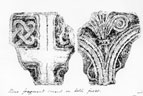
A (broad): This face is decorated with a relief cross, only the upper limb of which is intact. Each of the arms, save that to the left, has an incised central line stopping short of the point of junction of the arms. In the angle between the arms to the upper left is a motif composed of two ovoids set at 90 degrees to each other, and interlacing where they cross. In the corresponding positions to the upper and lower right are the remains of similar motifs. The field to the lower left is destroyed.
C (broad): On this face two curving quadruple roll mouldings converge, and meet towards the lower edge. Between them is a bundle of narrow half-round stems held at the base by a pelleted collar. The stems fan out, and the outer stem to the right is tightly scrolled. At the base one of the stems is carried beneath the moulding to the left and right before looping back again.
Discussion
The original function of this carving is problematical. As it is decorated on both faces it may have been a closure slab and may, therefore, have been free-standing. It must originally have measured c. 70 x 55 cm, the same size range as the possible closure slabs from Hexham, Northumberland, and Sonning, Berkshire, described above (Chap. VII). However, the decoration on face A, a Latin cross with interlace in the re-entrant angles, fits the field precisely. In contrast the decoration on face C, the junction of two reeded arch heads with plant ornament in the spandrel, was clearly intended to continue onto other slabs. This may simply reflect differing decorative schemes on each side of the original screen; it may, however, suggest that the slab has been reused, in which case interpretation of the function of the stone is more open. Perhaps the arch heads originally related to a frieze or blind arcade such as that postulated at Sompting (nos. 9–11; Ills. 172–80). The piece may then have been reused to form a small grave-cover or -marker. There is a very similar grave-cover from Little Shelford, Cambridgeshire, for example (Fox 1920–1, no. 21, pl. v).
Date
Eleventh century
References
Puckle 1864, 71 - 2, fig. facing 72; Irvine 1877a, 219; Knocker 1932, 44, pl. on 44; Cottrill 1931, appendix; Tweddle 1986b, i, 81 - 2, 179, 185, ii, 381 - 2, iii, fig. 4
D.T.
Endnotes