Volume 4: South-East England
Select a site alphabetically from the choices shown in the box below. Alternatively, browse sculptural examples using the Forward/Back buttons.
Chapters for this volume, along with copies of original in-text images, are available here.
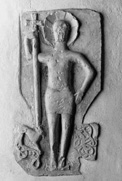
Current Display: Jevington 01, Sussex


Incorporated internally into the south face of the north arcade at the west end
Discovered in 1785 by Sir William Burrell 'in a stone chest', when second stage of tower refloored; originally fixed over south door, inside
Sub-rectangular panel decorated with a half-round, full-length, frontally-placed figure. It has a dished cruciform nimbus, and wears a short featureless skirt. The legs are together, but the feet and suppedaneum are broken away. The figure's left arm is bent so that the hand is placed palm outwards, touching, but not resting on, the hip. The right arm is extended and bent upwards at the elbow. The hand is turned inwards at the wrist to hold the shaft of a long-stemmed cross. This has a splayed-armed cross-head. The lower end is thrust into the mouth of an inward-facing animal at the foot of the figure. The head of the animal is up-turned and backward looking, with an open mouth, reversed lentoid eye, and pointed ears. Its body and front legs are naturalistically treated, but the front legs rest on interlacing loops developing from the back legs. A tail with a lobed tip curls down and across the hindquarters. To the figure's left is a second inward-facing animal. This has a low relief, contoured, ribbon-like body which develops into interlacing coils. The jaws are drawn out and back. There is a reversed lentoid eye and small oval ears. The animal is in combat with a second similar, but smaller, ribbon-like animal. The panel tapers abruptly below the level of the figure's waist but widens irregularly to accommodate the two animals.
Appendix A item (stones dating from Saxo-Norman overlap period or of uncertain date).
The panel has been re-shaped to the lower left and right to leave the animals to either side of the foot of the figure projecting. The figure is identified by its cruciform nimbus as Christ, and the careful differentiation of the two animals at his feet suggests that the piece depicts Christ as treading on the beasts, as in Psalms 91, 13. This differentiation in form between the two animals is echoed in pre-Conquest depictions of this scene, most notably in Oxford, Bodleian Library MS Douce 296, fol. 40r (Temple 1976, no. 79, 96–7, ill. 259) and New York, Pierpont Morgan Library MS 869, fol. 13v (ibid., no. 56, 74–5, ill. 168). There seems little doubt, however, that this piece belongs to the immediately post-Conquest period. The left-hand animal is plainly in the Urnes style, and the right-hand animal shares elements of this style. The Urnes style developed in Scandinavia c. 1025–50, but probably did not reach England until after the Conquest (Wilson and Klindt-Jensen 1966, 153, 160).
Stones dating from Saxo-Norman overlap period or of uncertain date in late eleventh century
Horsefield 1835, i, 288; Hussey 1852, 245; Lower 1870, ii, 1; Allen 1887, 276 - 7; André 1898, 18; Legge 1901, 152 - 3, fig. on 152; Keyser 1904, lv; Page 1907, 364, fig. on 363; Jessep 1914, 32, 61; Row 1914, 52; Hartland 1918 - 19, 153; Brown 1925, 462; Cottrill 1931, appendix; Mee 1937, 230; Kendrick 1949, 120, pl. LXXXV; Gardner 1951, 42, fig. 64; Rice 1952, 95, 100 - 1, 131, pl. 10a; Moe 1955, 18; Stone 1955, 47, pl. 29; Rice 1960, 206; Quirk 1961, 31; Fisher 1962, 375; Taylor and Taylor 1965 - 78, i, 350; Nairn and Pevsner 1965, 42-3, 546; Wilson and Klindt-Jensen 1966, 154, pl. LXXIXa; Fisher 1970, 134; Smart 1973, 20 - 1; Kirby 1978, 165; Laing and Laing 1979, 179; Owen 1979, no. 20, 150 - 1, 157, 169, 174, 228, pl. 20; Graham-Campbell 1980a, 152; Roesdahl et al. 1981, no. L10; Tweddle 1986b, i, 78, 214 - 7, ii, 394 - 5, iii, pls. 53b, 54a
D.T.