Select a site alphabetically from the choices shown in the box below. Alternatively, browse sculptural examples using the Forward/Back buttons.
Chapters for this volume, along with copies of original in-text images, are available here.


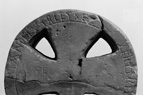
Object type: Cross-head, in two joining pieces
Measurements: Diameter c. 53 cm (21 in). D. 10 cm (3.9 in)
Stone type: Light grey to brownish-grey, fine-grained (0.1–0.2 mm quartz grains) sandstone, with a very few 0.2-mm dark grains and no obvious cement; of uncertain provenance, perhaps Lower Cretaceous rather than Tertiary, and possibly Wealden
Plate numbers in printed volume: Ills. 343-344
Corpus volume reference: Vol 4 p. 221-223
(There may be more views or larger images available for this item. Click on the thumbnail image to view.)
It is a form of circle-head with arms of type E8, broken roughly horizontally below, the lower arm and lower parts of the horizontal arms being lost. The sides of the expanding arms are concave, and the re-entrant angles acute. The ends of the arms are separated by incised lines from a narrow ring of rectangular section encircling the head. Traces of black and red paint survive on both broad faces (Tweddle 1990, 150 - 1). Only face A is carved.
A (broad): Inscription The inscription (Okasha 1967; eadem 1971, 99; eadem 1992b, 335–6, 342, 345) is incised around the circumference of the ring. The letters run, with their feet facing towards the centre, between an incised circle which acts as the lower framing line and the outer edge of the face. The diameter of the head is about 53 cm (21 in) and the distance between the incised circle and the edge of this face is about 4.5 cm (1.8 in). The height of the letters is around 4 cm. The two cut-out sectors, which are clumsily carved in comparison with the cutting and dressing of the rest of the head, are probably secondary and, on the right-hand side, cut into the inscribed area.
Okasha states that the '...inscribed face of the stone appears to have borne some red paint, both on the letters and on the central plain portion.' (Okasha 1967, 249; cf. Tweddle 1990, 150–1). Traces of red paint are still visible in one or two places on this face. Some colour can be seen within the (probably secondary) cut-out sectors, which suggests that, at least there, it is not primary. Small quantities if orangeish pigment can also be seen in the central serif of the first E and at the top of the first R. (There are also a few splashes of red wall paint.)
The inscription is damaged and incomplete at either end. What remains may be transcribed as follows:
--[S]TAN[ǷE]L[V.]RLE[TSE...--F]ER[H/E]R[E]--
There are some uncertain readings. The character transcribed as wynn could perhaps be thorn, or even D (Okasha 1967, 250). Between the letters V and R there is a stroke which leans markedly to the left away from the vertical. It may have been intended as a vertical and therefore perhaps as the letter I (Okasha 1967, 250). (The verticals of some other letters also lean away from the perpendicular.) If it was intended as a diagonal, it might have formed the right leg of an A but, if so, there is no trace of the rest of the letter. The bottoms of strokes of three probable letters are still traceable after the group LETSE. These are two verticals and two converging diagonals. These are compatible with the letters TTA, and in the context can probably be read as part of the formula let settan (Page 1971, 178). The probable F shortly after these letters seems to have been in ligature with Y or V. The ligatured letters, transcribed here as H/E, are less than certain because the verticals seem to have converged towards the top. Alternative readings would be A and E in ligature, or the Æ diphthong. H/E is, however, the most probable reading. The text is in Old English, and can perhaps be read as follows:
--[S]TAN ǷELV[I]R (or ǷELV[A]R) LET
SE[TTAN] [.F]ER [H]/ERE--
This would mean: '--Welv[i]r (or Thelv[i]r, or Delv[i]r, or Welv[a]r, etc.) caused ... stone to be raised over [H]ere --. There are other possible ways of dividing the first three syllables (Okasha 1967, 250–1; eadem 1971, 99) but this seems the most satisfactory.
The lettering is shallowly cut and rather loosely designed. Some of the verticals are out of the perpendicular. Vertical strokes go down to the incised circular framing line but, to avoid losing the bottom horizontals of E and L by cutting them along the framing line, the letter-cutter has placed the horizontals some way above the framing line, with the effect that the verticals of E and L project below the bottom horizontals. The top edge of the inscription is worn and damaged, and so it is not always clear how letters finished at the top. The verticals of two of the Es (the first and the antepenultimate) seem also to project above the top horizontal as well as below the bottom one. Several of the strokes terminate in what Okasha has called 'dot seriffing'. These dots are not very deep. They were perhaps executed with a drill or by revolving a mason's point.
Apart from the unusual form of E with extended verticals described above, the letter forms are mostly Roman capitals or variants of them. The following are worthy of comment. A has an angular cross-bar and a bar over the top which meets the diagonals shortly before the point at which they would converge. The extension of the vertical of the L below the horizontal is analogous to the treatment of the E. N is the non-Classical form in which the diagonal meets one or both of the verticals short of the end. The R is an angular version of the letter which is very similar to the open form of runic 'r' as seen, for example, on Dover St Peter 1 (Ill. 76). The Old English graph wynn seems to be used for W, although, as noted above, thorn and D are other possible readings. There are one fairly certain and one possible example of ligaturing of letters. Words are undivided and there is no remaining evidence of punctuation.
The form of the piece suggests a late date, that is, in the tenth or early eleventh century. As Collingwood has pointed out, circle- and plate-heads are variants of the ring-head, which was probably introduced to England by Scandinavian settlers in the early tenth century (Collingwood 1927, 137–9, fig. 153). The fact that no cross-head in England of this type has pre-Viking ornament, and that the surviving examples have decoration which depends on Scandinavian or Scandinavian-derived motifs lends strong support to Collingwood's dating (Bailey 1978, 178–9).
Inscription Page thinks that the underlying formula of the text is 'NN let settan ofer Here-' (Page 1971, 178). He follows Okasha in suggesting ofer as the reconstruction for [.F]ER (Okasha 1967, 250–1; cf eadem 1992b, 335–6), but points out that it would be unparalleled in Old English, which would prefer æfter. They point, however, to the occasional use of yfir in similar contexts on Danish and Norwegian rune-stones and on one example on Iona. The letter in apparent ligature with F in this word could well be Y or V (giving [YF]ER or [VF]ER, a reading which would strengthen the suggestion of Old Norse influence). Okasha further suggested that Old English stan, if used in the sense of a 'grave-stone', might also reflect Old Norse usage (Okasha 1967, 250–1). Old Norse steinn is commonly used with this meaning on Scandinavian rune-stones.
The partially surviving portion of the inscription thus seems to have recorded both the name of the person who commissioned this monument and the name of the individual whom it commemorated and whose grave it perhaps marked. The formula used here seems to have been a variant of the quite common Old English X sette æfter Y (Higgitt 1986, 133). Analogous Latin formulae recording that X raised the cross pro anima or just pro Y are used on seven of the Welsh crosses (Higgitt 1986, 139).
The text seems to have contained two names. Okasha discusses Old English and Old Norse personal name elements that might lie behind the first probable name in the inscription (Okasha 1967, 250; eadem 1992b, 342). The second name fairly certainly began with the element Here-, a common Old English personal name element (Searle 1897, xvii, 292–5).
The use of dot seriffing is unusual in Anglo-Saxon inscriptions, but there are examples on stone at Bishopstone 1 in Sussex (Ills. 6–7) and Thornton le Moors in Cheshire, and on a piece of late Anglo-Saxon metalwork from Sandford, Oxfordshire (Okasha 1971, pl. 106; Higgitt 1983, 27–8; Okasha 1992a, 54–5; Hinton 1974, 56–60). Dot serifs are an embellishment that seems more natural to metalwork where they can be made simply with a punch, as they were on the Sandford inscription.
The apparent form of E with extended vertical is rare in Anglo-Saxon inscriptions, though it is used in the maker formula on the cross-shaft from Alnmouth, Northumberland (Okasha 1971, pl. 2a; Cramp 1984, ii, pl. 157 (810)). It is a common form in pre-Carolingian Frankish inscriptions and appears occasionally in early medieval inscriptions in Britain, for example, at Lethnott (Angus), and Aberdaron and Penmachno (Caernarvonshire), and in the display script of Insular manuscripts (Deschamps 1929, 11, 65–80; Higgitt 1982, 315; Okasha 1985, 47, pl. III; Nash-Williams 1950, 84, 224–5, figs. 62, 81, pl. VIII; Alexander 1978, ills. 49, 60, 68). The Ls on the cross-head are analogous in form to the Es.
The letter forms and seriffing on this stone are quite unrelated to those on the cross-shaft fragments from this site (no. 1). The cross-head lettering is in capitals and that on the shaft fragments in a mixed script. The shaft lettering is likely to be earlier, or at least has more affinities with early lettering. The Es and Ls on the present piece also look like an early form, although it could be a revival or an independent invention. Capitals are used, but in their irregularity, their unusual, perhaps archaic, forms of E and L, and the rune-like R, they are quite unlike the regular and comparatively Classical capitals of most pre-Conquest inscriptions in the south-east. They could be earlier, or, perhaps, just less influenced by the style of the lettering of the monastic reform period.
The placing of an inscription on the head of a cross is not unusual in Anglo-Saxon England (Higgitt 1986, 130). However, if we accept the suggestion made above that the original form of this cross-head was an unpierced disk, the only other example in the British Isles of an inscription in the outer ring of such a cross-head seems to be at Margam (Glamorganshire) (R.C.A.H.M.W. 1976, 46–8, pl. 8). The closest formal parallels for inscriptions ranged round a circumference in this way are on the circular sundials at Aldbrough, Yorkshire (Higgitt in Lang 1991, 123, ill. 418) and Orpington, Kent (Ill. 105). It is uncertain, of course, whether no. 2 was originally completely circular, and, if so, whether the inscription followed the entire circumference.
