Select a site alphabetically from the choices shown in the box below. Alternatively, browse sculptural examples using the Forward/Back buttons.
Chapters for this volume, along with copies of original in-text images, are available here.


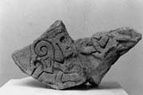
Object type: Part of grave-marker
Measurements: H. 23 cm (9 in); (W. 43 cm (17 in); D. 13 cm (5 in)
Stone type: Yellowish-grey, medium- to coarse-grained oolitic limestone, with a few shell fragments and one distinct calcite veinlet; a pinkish tinge on the front surface suggests burning; Combe Down Oolite, Great Oolite Formation of Bath area, Great Oolite Group, Middle Jurassic
Plate numbers in printed volume: Ills. 341-342
Corpus volume reference: Vol 4 p. 223-224
(There may be more views or larger images available for this item. Click on the thumbnail image to view.)
Two sub-triangular fragments fit together to form part of a grave-marker, roughly in the shape of a parallelogram. All the edges are roughly broken. The stone is decorated in the Ringerike style.
A (broad): Ornamented with the fore quarters of an animal. One leg, with an incised spiral hip, is arranged vertically, passing behind the other front leg which is extended almost horizontally and terminates in two curved claws. A foliate or interlace strand developing from the lower left loops around both legs before being carried up to join a series of tendrils or interlacing strands to the upper right.
C (broad): The centre of a cross with expanding arms survives, their junction enclosed by a circle defined by a broad, flat strand with which the ends of the arms interlace. They stop against the edges of a concave-sided lozenge contained within the circle, which is defined by broad bands. The points of the lozenge are extended beyond the circle, between each pair of cross-arms, but are then broken away.
B, D and E (narrow sides and top): Broken away.
The fact that this piece has decoration both on the front and the back demonstrates that it was free-standing. The animal on face A links it with the St Paul's headstone (Ill. 351) and may suggest a similar function. A memorial function is supported by the occurrence of a cross on face C, as on Rochester 3 (Ill. 148).
As with two carvings from London (St Paul's 1 and City 1), Rochester 2–3, and the fragment from Great Canfield, Essex (Fig. 32), this piece is decorated in the Scandinavian Ringerike style. This was current in Scandinavia from the late tenth century to the third quarter of the eleventh century (Wilson and Klindt-Jensen 1966, 145–6). In England the style probably belonged to the period of Scandinavian rule, from 1016–42 (ibid., 145), which would serve to date no. 3 fairly precisely. There are so few Ringerike-style sculptures from the region, their distribution is so restricted, and the style of carving so similar, it is tempting to regard them as the products of a single workshop.
