Select a site alphabetically from the choices shown in the box below. Alternatively, browse sculptural examples using the Forward/Back buttons.
Chapters for this volume, along with copies of original in-text images, are available here.


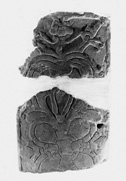
Object type: Part of grave-cover, in two pieces [1]
Measurements:
a: H. 47.5 cm (18.7 in); (W. 55.5 cm (22 in); D. 19.5 cm (7.7 in)
b: H. 37 cm (14.6 in) (W. 51 cm (20 in); D. 19.5 cm (7.7 in)
Stone type: Pale brown, fine-grained (0.1–0.2 mm quartz grains) sandstone, with a small proportion of very fine (0.1 mm or less) dark grains, and no obvious cement or bedding; of uncertain origin, perhaps Lower Cretaceous rather than Tertiary, and possibly Wealden
Plate numbers in printed volume: Ill. 353
Corpus volume reference: Vol 4 p. 228-229
(There may be more views or larger images available for this item. Click on the thumbnail image to view.)
Two fragments of a tapering grave-cover.2
A (top): Fragment a is broken roughly horizontally below, but irregularly above. The break rises from right to left. The upper left-hand corner is lost. Along the long edges of the convex upper face are narrow, plain, raised borders. The face is decorated in low, flat relief with a prominent cross placed diagonally, with bulbous, rounded-ended arms tapering markedly towards their inner ends and separated from the point of junction by pairs of transverse incised lines. From each re-entrant angle develops a pair of foliate tendrils which are linked together to encircle the cross-arms. To the left and right are three-element axial growths. Above, subsidiary tendrils run diagonally upwards to the left and right, with lobe-like axial growths at the junctions with the tendrils surrounding the cross-arms. In the V-shaped field thus created is a second pair of tendrils arranged in a V-shape with inward-facing, tightly-curled ends.
Fragment b is roughly broken horizontally above and below, but irregularly to the left. Along the right-hand edge of the convex, foliate decorated upper face is a narrow, plain, raised border. The face is decorated in low, flat relief with a pair of swags developing from the upper, broken, edge, and linked on the vertical axis by a union knot. Each swag is composed of three or more foliate tendrils. From them subsidiary groups of tendrils break away diagonally towards the lower left and right-hand corners. Of these only the left-hand group is well preserved with a branch from the outer tendril looping back around the inner tendril before dividing into two. Each division has a tightly-curled tip. The inner tendril breaks back and upwards towards the vertical axis of the stone, where it meets a similar tendril emerging from the damaged area to the right. On the vertical axis, developing from the lower edge, are two lobes clasped by a union knot.
