Select a site alphabetically from the choices shown in the box below. Alternatively, browse sculptural examples using the Forward/Back buttons.
Chapters for this volume, along with copies of original in-text images, are available here.


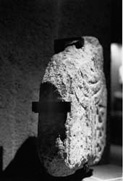
Object type: Part of grave-cover
Measurements: L. 63 cm (24.8 in) (W. 54.5 cm (21.5 in) D. 12 cm (4.7 in)
Stone type: Pale yellowish-grey to yellowish-brown, medium-grained, shelly, oolitic limestone; probably Barnack stone, Lincolnshire Limestone Formation, Inferior Oolite Group, Middle Jurassic
Plate numbers in printed volume: Ills. 345-346
Corpus volume reference: Vol 4 p. 224
(There may be more views or larger images available for this item. Click on the thumbnail image to view.)
Part of a tapering grave-cover, broken horizontally below and irregularly above. The break rises gently from left to right, but the upper right-hand corner is lost. Only one face is carved.
A (top): Along the left- and right-hand edges is a narrow, plain, raised border, the inner edge to the left also being defined by an incised line. There is a broad, plain, low-relief median moulding. This has a median-incised line which terminates in a drilled hole where the median moulding unites with a broad U-shaped moulding defined by incised lines at the upper end of the stone. This is placed open end outwards and is median-incised. The incomplete field defined by this moulding is undecorated apart from a pair of closely-spaced, parallel, incised lines developing from the broken edge to the right of the vertical axis of the stone, and sloping down to the right. They stop short of the U-shaped moulding. Below, to the right of the median moulding and bounded by it and the right-hand border, is an incomplete rectangular panel decorated with a low relief four-strand plain plait. The field between the median moulding and the left-hand border is dressed roughly flat.
