Select a site alphabetically from the choices shown in the box below. Alternatively, browse sculptural examples using the Forward/Back buttons.
Chapters for this volume, along with copies of original in-text images, are available here.


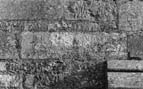
Object type: Grave-cover
Measurements: L. c. 100 cm (39.4 in) W. c. 30 > 25 cm (11.8 > 9.8 in) D. Built in
Stone type: [Ancaster Freestone, Upper Lincolnshire Limestone, Inferior Oolite Group]
Plate numbers in printed volume: Ill. 399
Corpus volume reference: Vol 5 p. 280
(There may be more views or larger images available for this item. Click on the thumbnail image to view.)
A simple, slightly tapered flat grave-cover. Only one face is visible.
A (top): Undecorated except for a type A1 cross formed of two intersecting incised lines in the upper third of the stone. The incised lines are not of great depth, though the stone may have been somewhat abraded prior to its reuse as walling material.
Appendix A item (stones dating from Saxo-Norman overlap period or of uncertain date).
This is an example of a well-known form of grave-cover. A group of similar, simple stones from The Hirsel, Berwickshire, has been discussed by Cramp (Cramp and Douglas-Home 1977–8), and there are examples in Lincolnshire at North Witham (no. 2, Ill. 425), and Lincoln St Mark (nos. 21 and 22, Ills. 405, 406). The St Mark's examples can be dated by their archaeological context to the period between the tenth and the twelfth century (Stocker 1986a, 66, 69). It must be said, however, that these designs are so simple (and so obvious) that, in principle, neither earlier nor later medieval dates should be ruled out. In the Hough case, however, the aisle (into the north wall of which the cover is built) is of thirteenth-century origin and, thus, a date between the tenth and the twelfth century for the grave-cover is quite satisfactory.
