Select a site alphabetically from the choices shown in the box below. Alternatively, browse sculptural examples using the Forward/Back buttons.
Chapters for this volume, along with copies of original in-text images, are available here.


Object type: Grave-cover
Measurements: L. 225 cm (88.6 in) W. c. 50 cm (19.7 in) D. Built in
Stone type: [Ancaster Freestone, Upper Lincolnshire Limestone, Inferior Oolite Group]
Plate numbers in printed volume: Fig. 9; Ill. 215
Corpus volume reference: Vol 5 p. 186-187
(There may be more views or larger images available for this item. Click on the thumbnail image to view.)
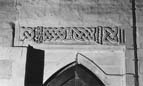
The visible face is the flank of a mid-Kesteven type grave-cover. The stone has a rebate along its lower edge which aligns with the frame of the door below and was presumably cut when the stone was reset in this position. This work of setting the stone in the wall to serve as a lintel was done very carefully and it is probable that, as part of the same work, a border moulding was removed from around the whole edge of the stone. This seems to be confirmed by an undecorated frame at the present western end which stands proud of the remainder of the arrises. Certainly no other members of this otherwise very homogeneous group of grave-covers lack arris mouldings in this way.
B (long): The decoration on the only visible face is divided into a pair of small square panels (at either end) separated from a long horizontal panel by complex mouldings. The present easternmost panel is separated from the central by a single strand which loops backwards and forwards on itself. One end has an almost anthropomorphic or foliate terminal. The equivalent border at the western end is a pair of cable mouldings of differing type connected by a single thread. Within the panels at either end are two interlace motifs with strands decorated by an incised medial line – to the east a unit of motif ii and to the west a unit of motif iii (Fig. 10) .
The long central horizontal panel is filled with two asymmetrical runs of four-strand plait either side of a centrally placed 'bull's head' (Fig. 11). To the east is a unit of half pattern F with unpinned terminals, to the west a unit of half pattern F with the terminals cross-joined. The plait develops out of the bull's horns. The bull's head itself is decorated both with the medial line, which continues from the interlace and crosses over the nose, and with a nose-band in relief decorated with incised zig-zag.
Below, the square muzzle is modelled to give the appearance of nostrils. The design appears to be offset within the present stone, which is further evidence that this is indeed the decorated flank of a grave-cover of mid-Kesteven type, with the decoration set above an undecorated plinth.
This is clearly a member of the mid-Kesteven group of grave-covers (Chapter V) and it is decorated with the characteristic layout and style of interlace. As it stands now, however, it has two features which make it unique within the group. First, it has no border moulding around the main panels, and secondly the vertical strips of decoration separating the three decorative panels are highly eccentric in their design. In our view, both of these anomalies must be accounted for by recutting which was clearly undertaken when the stone was reset in its present position.
There is some evidence that the undecorated border which survives at the western end originally continued around the whole face, but this border would have to be removed, at least along the lower edge, when the stone was reset – as this edge was recut to complete the door frame. The vertical border mouldings dividing the three panels have no parallels anywhere else in the Anglo-Saxon sculpture of the East Midlands and, consequently, it is very tempting to see both mouldings as recuttings also. If this is the case it can be speculated that these borders were originally the typical double cable mouldings usually found in these positions and that they were recut when the frame was removed to make way for the rebate along the underside. It is also possible that some of the interlace work may have been re-tooled at this time to remove any weathering, as it is now in remarkably good condition. It is therefore probable that this was originally an orthodox member of the mid-Kesteven group, produced in the later tenth century, which has been extensively recut in the fourteenth century.
Such a careful recutting of an early stone is, of course, of very great interest. It suggests that the stone was selected for reuse in this position not only because of its great size but also, at least partly, because of its decoration, which was safeguarded by these small adjustments to its detail. It is also possible that the stone was placed over the doorway to associate the new structure with the earlier Christian history of the site and, given the superstitions surrounding the church doorway, the action of resetting the stone may even have been thought talismanic (Stocker with Everson 1990, 95).
Within the county this iconic reuse of early sculpture in later doorways also occurs at Crowle (where the cross-shaft no. 1 was reset in this way over the west door until after the First World War), and probably also at several other places (ibid., 88–9).
