Select a site alphabetically from the choices shown in the box below. Alternatively, browse sculptural examples using the Forward/Back buttons.
Chapters for this volume, along with copies of original in-text images, are available here.


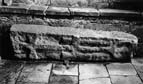
Object type: Grave-cover
Measurements: L. 190 cm (74.8 in) W. 52 > 43 cm (20.5 > 16.9 in) D. 25 cm (9.8 in)
Stone type: Pale yellowish grey (10YR 8/1–2) coarsely shelly, pelletal oolitic limestone; the groundmass, of ooliths of 0.4 to 0.6mm diameter in a hard calcite matrix, having streaks packed with thin arcuate shell fragments and irregular pellets of 3 to 5mm diameter, some of them apparently micrite-filled gastropods; at the lower end of the stone as carved is a disordered accumulation of pellety detritus. Upper Lincolnshire Limestone, Inferior Oolite Group, less regularly bedded and more pellety than typical Barnack Rag
Plate numbers in printed volume: Ill. 220
Corpus volume reference: Vol 5 p. 188-189
(There may be more views or larger images available for this item. Click on the thumbnail image to view.)
A large flat tapered grave-cover with decoration in relief on its upper surface only. In section the sides are deliberately canted.
A (top): The decoration consists of three crosses, a large central one flanked by two smaller examples. The surface deterioration is at its worst in the centre of the stone so that the two smaller crosses can only be read with very great difficulty. The central cross has slightly splayed side arms of type B6, but the upper arm expands into a type E1 terminal with outward-curving tips. The stem of the cross rises from a trident base with a raised bar across the foot. The two smaller flanking crosses have straight transverse arms but their upper arms are slightly splayed. These two crosses both have outward-curving feet.
B–F: In the narrow end there is a rebate about 1cm deep running through the whole depth of the stone. The bottom of the slab has been worn smooth by abrasion, presumably during the reuse of the cover as a bridge.
For Lincolnshire, this is a well-known monument, an engraving of it having appeared in the Archaeological Journal (Way 1870). The decoration of the cover with three crosses on a schematic Calvary mound is of great interest. Representation of the three crosses on a Calvary mound has been considered to be a very early iconography, originating in Merovingian Gaul in the seventh century (Lionard 1961, 101–5) and there is a ninth-century example from Whithorn, Wigtownshire (Collingwood 1927, fig. 10; Radford and Donaldson 1953, 40). Following such examples, Davies dated the Howell piece to the Anglian period (1926, 14), but several other commentators have placed the cover in the eleventh century (Way 1870, 197; Fox 1920–1, 15; Butler 1964, 113). The arguments for the later date seem overwhelming. Though all three crosses on the Howell grave-cover have odd characteristics, these are, however, also all found on other tenth- and eleventh-century examples in Lincolnshire. They have long shafts with cross-arms mixing splayed with straight elements, as is found, for example, at Carlby 2, Castle Bytham 1, Langton by Wragby 1–2 and Lincoln St Mark 19 (Ills. 84, 88, 228–9, 261–2). The two subsidiary crosses at Howell have the same curious, outward-curving feet found at Lincoln St Mark 6 and 13 and St Paul-in-the-Bail 2 (Ills. 244, 254, 277). The central cross at Howell also has a trident Calvary mound which is very similar to that on Lincoln Cathedral 1 and is also seen on Lincoln St Mark 24 (Ills. 230, 412). These parallel examples of such distinctive features are placed (with some certainty) in the period between the mid tenth and the late eleventh centuries.
To confirm the later date as much the most probable for the Howell grave-cover, we should note that the three crosses on Calvary motif was a well-known iconography in tenth- and eleventh-century Lincolnshire, and is seen on Lincoln St Mark 7 and 17, Hackthorn 1 and Lincoln City 1 (Ills. 249, 256, 189, 231). Howell 1, then, is best seen within this group of tenth- and eleventh-century Lincolnshire grave-covers rather than as an early import. Furthermore it seems likely that the Howell cover comes relatively late in the Lincolnshire sequence. It has a pronounced taper, no interlace and the crosses are executed in relief without an enclosing frame. All these would seem to be signs of a relatively late date, when compared with the parallels cited, placing the monument in the eleventh century rather than the tenth and not necessarily before the Conquest.
The rebate in the narrow end of the cover is of interest. It may be a secondary feature unconnected with its original function, but it might also be a rebate to allow the setting of an upright marker (perhaps a wooden cross) at the foot end of the grave. Eleventh-and twelfth-century parallels can be found for this interlocking of horizontal and vertical items of tomb furniture, for example at Kirk Merrington, co. Durham (Lang 1974, 104–5), where the vertical components seem to have been of stone. This rebate, then, might be further evidence for the presence of timber crosses alongside the stone covers, like that which seems to be depicted on Lincoln St Mark 17 (Ill. 256).
