Select a site alphabetically from the choices shown in the box below. Alternatively, browse sculptural examples using the Forward/Back buttons.
Chapters for this volume, along with copies of original in-text images, are available here.


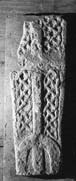
Object type: Grave-cover, in two nearly adjacent pieces [1]
Measurements:
a: L. 56 cm (22 in) W. 48 cm (19 in) D. 10.5 cm (4.25 in)
b: L.96 cm (37.75 in) W. 54 > 40 cm (21.25 > 15.75 in) D. 10 cm (4 in)
Stone type: Yellowish-grey (2.5Y 8/3–4) planar-bedded shelly oolite, with ooliths most noticeably around 0.5 to 0.6 mm in diameter but with small interstitial ones of 0.2 to 0.3 mm diameter, and much 5mm shell detritus. Barnack Rag type, Upper Lincolnshire Limestone, Inferior Oolite Group
Plate numbers in printed volume: Ill. 230
Corpus volume reference: Vol 5 p. 194-195
(There may be more views or larger images available for this item. Click on the thumbnail image to view.)
Two conjoined pieces from a flat tapering grave-cover. The break is noticeably straight and at right angles to the length of the stone, which might suggest that it had been split cross-wise for secondary use. Against this, the contemporary drawing deposited with the Society of Antiquaries of London by Venables shows that the break lay across the interlace panels rather than against the lower edge of the cross-arm. The two pieces also formed a tight join without loss of the carved pattern. This argues an accidental fracture in situ, or in its removal on discovery, rather than splitting by a mason for piecemeal reuse. Venables consistently refers to it as a single item. After its travels around the cathedral, stone 1a may have been trimmed straight for resetting on its present support, which has resulted in the pattern not now quite cohering. Compared with the drawing, it has been additionally damaged and rough trimmed along one side and end, but otherwise this probably represents a complete cover.
A (top): Decoration is confined to the upper surface and is in low relief. It is organised around a plain cross with a rectangular arm and slightly splayed cross-arms (a combination of types A1 and B6) that extend to the edge of the stone, and a U-form tridentine foot that fills the bottom end of the cover. The central shaft ends in a point, which is probably skeuomorphic. A plain rectangular border is subsidiary to the central motif. The panels thereby defined are filled with a simple four-strand plait, carefully organised and executed to be identical to left and right of the cross-shaft and to accommodate the tapering fields.
The find location is important. Mansel Sympson (1906, 159–60) makes the erroneous assumption that this cover was discovered in the cathedral like the marker (Lincoln Cathedral 2), reused as flooring. In contrast, Venables' evidence shows rather that it was found in situ within a graveyard extending to the west of the cathedral's west front that is known from occasional discoveries of oriented skeletons (Jones, Major and Varley 1987, 91). The cover exhibits signs of heavy weathering on its upper surface, and was apparently complete when found, both of which support the probability of its discovery in situ. As such, it is the first secure evidence of a pre-Conquest date for this graveyard, which therefore pre-dates the Norman cathedral: Venables was wrong, however, to identify it as that of St Mary Magdalene (see Srawley 1966, 22–3).
This cover forms an interesting link between several local late Saxon traditions. Its cross-head type associates it with a large group of monuments utilising the same type, from Hackthorn 1 (Ills. 187–9) and Lincoln City 1 (Ill. 231) of the mid tenth century onwards. In its completely infilled panels of interlace, it looks both south to Ewerby 1 (Ill. 170) and north to the covers from York Minster and elsewhere in that city (Pattison 1973; Lang 1991), without in either case matching their inventiveness. Closer comparisons, as noted by Fox (1920–1, 24–5), are found in the more routine products patronised in the Cambridge area and produced from the Barnack quarries (see Chapter V and Table 5). In particular, covers from Grantchester (Cambridgeshire), Milton Bryan (Bedfordshire), Raunds (Northamptonshire), Huntingfield (Suffolk) and three from the excavations at Cambridge Castle (Fox's group A type 2) exhibit a combination of plain cross-heads and complex lower terminals of U- or V-form with infilling interlace (Ill. 486). By contrast, on the closest Lincolnshire analogy at Ewerby the U-shaped Calvary foot is made up of interlace (Ill. 170). At both Howell 1 (Ill. 220) and Lincoln St Mark 24 (Ill. 412) closely similar U-form tridentine motifs appear without any associated interlace: they are in those instances likely to be of later eleventh- or even early twelfth-century date rather than earlier, and lead into a tradition of design whose occurrence in the twelfth century is not limited solely to Barnack workmanship (Butler 1952, 34–5; id. 1957; id. 1964, 119). The parallels from Cambridge Castle, however, point to a date before the mid eleventh century.
Perhaps the most interesting aspect of this cover is its appearance, as a Barnack product, in Lincoln itself, given the probability that covers, many of them of quality and distinctive local style, appear to have been manufactured there from the early to mid tenth century onwards.
Butler, in discussing a Lincolnshire group of monuments deploying a cross pattée design, notes that 'this pattern had already been employed in the Anglo-Saxon period (c. 1000–1050) upon an interlaced memorial slab now lying loose in the cloisters of Lincoln Cathedral' (1961, 32). He seems clearly though inaccurately to be referring to this, rather than a separate item.
