Select a site alphabetically from the choices shown in the box below. Alternatively, browse sculptural examples using the Forward/Back buttons.
Chapters for this volume, along with copies of original in-text images, are available here.


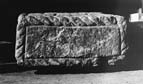
Object type: Grave-marker [1]
Measurements: H. 90 > 85.5 cm (35.5 > 33.5 in) W. 58 cm (22.75 in) D. 26 cm (10.25 in)
Stone type: Yellow-brown (10YR 8/4–6) even-grained oolite, with ooliths of 0.5 to 0.6 mm diameter, showing as empty cavities in a calcite matrix on the stone surface; no obvious shell detritus or bedding. Upper Lincolnshire Limestone, Inferior Oolite Group [but not Ancaster or Barnack types]
Plate numbers in printed volume: Ills. 232–4
Corpus volume reference: Vol 5 p. 196
(There may be more views or larger images available for this item. Click on the thumbnail image to view.)
A complete upright rectangular grave-marker reusing a large block of Roman masonry. An elongated rectangular hole 3 cm (1.25 in) deep in the centre of its decorated broad face is a Lewis hole for lifting the block. The top of the marker is on a pronounced slant because of the received shape of the stone, which no attempt is made to correct. The marker is decorated on one broad face, both narrow faces and its top.
A (broad): Decorated with a cable-moulded border that extends approximately 38 cm (15 in) down the arrises. Within, and with its outer upper arm abutting the upper border, is a double rectangular cross of type A1, one within the other, depicted through a pair of widely spaced incised lines. It is set square to the sides, ignoring the sloping top. The inner cross is a complete closed figure: the lower arm or stem of the outer cross fades out against the edge of the roughly dressed surface that occupies the lower half of the stone. As with the similar evidence on the other monuments of this type, this indicates that the marker was intended to be set firmly earthfast.
B and D (narrow) and E (top): These faces are decorated only with the cable moulding on their arrises.
C (broad): Undecorated; even the cable moulding is not carried round from adjacent faces.
This is one of the Lindsey group of closely similar rectangular markers, found with a restricted distribution in Lincoln city and Lindsey (see Chapter V and Table 7A). The rather stubby-armed cross on this piece finds its best analogy in Lincoln city on Lincoln St Mark 16 (Ill. 259); and the distinctively broad spacing of the incised double outline, which gives a clear impression of one cross within another, it shares with that piece from St Mark and a second from Lincoln St Mary-le-Wigford (no. 4, Ill. 268), in contrast with the more strictly double outline examples in Lindsey at Gayton le Wold (Ills. 180, 184), Glentworth (Ill. 179) and Hackthorn 2 (Ills. 191, 193). It exactly parallels St Mark 16, too, in that the outline of the inner cross is completed instead of extending downwards to ground level.
The date range of the group is defined on the one hand by its potential associations with the Lindsey covers (Chapter V) and on the other by the incorporation of the Glentworth example in the fabric of the presumably mid to late eleventh-century church west tower there, and, if it can be relied on, the reported incorporation of this example from the Cathedral in masonry of 1070+. Similar rectangular markers though with a plain border and single incised cross were found at Cambridge Castle also in an archaeologically pre-Conquest context (Kerrich 1814, pls. XV, XVI; Fox 1920–1, pl. VII; see Ill. 486).
