Select a site alphabetically from the choices shown in the box below. Alternatively, browse sculptural examples using the Forward/Back buttons.
Chapters for this volume, along with copies of original in-text images, are available here.


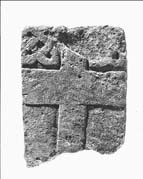
Object type: Part of grave-cover
Measurements: L. 38 cm (15 in) W. 28 > 26.5 cm (11 > 10.5 in) D. 12 cm (4.75 in)
Stone type: Pale yellow medium-grained oolite, with closely packed ooliths of 0.5mm diameter in a finely granular matrix. Most ooliths have vacated their sockets but calcite is not conspicuous in matrix. Upper Lincolnshire Limestone, possibly Ancaster Freestone
Plate numbers in printed volume: Ill. 248
Corpus volume reference: Vol 5 p. 203-204
(There may be more views or larger images available for this item. Click on the thumbnail image to view.)
The upper end of a small, flat and slightly tapered grave-cover or -marker, probably the former in view of weathering being confined to the one carved surface.
A (top): Decoration is in low relief. It is limited to a plain central cross with rectangular arms (type A1), which extend to the edge of the stone. The form of the cross's foot is lost, but has reasonably been assumed to have been similarly rectangular (Colyer 1976, fig. 3.7; Stocker 1986a, fig. 48). The upper two quadrants are filled by identical simple closed-circuit patterns with two oval loops (Cramp 1991, fig. 24B). There is no border.
B and D (long): Original dressed edge of cover.
C (end): Original end.
E (end): Roughly broken.
F (bottom): Original dressed surface.
This simple cover belongs to the local tradition of decoration based on a cross of type A1, with a date range extending from the mid tenth to the end of the eleventh century. Typically the spaces below the cross-arms are filled with interlace or other motifs, as at St Mark 6 and 7, Lincoln Cathedral 1, Ewerby 1 etc. It is possible that in this example similar decoration was merely painted rather than carved. A connection between this cover and St Mark 6 may be suggested by the mistake in that example in laying out its upper left-hand triquetra as if a four-point pattern was in mind, and by its similarly restrained decoration (Ills. 243–4). The four-point pattern is found, for example, on a bone buckle in the Yorkshire Museum (Roesdahl et al. 1981, 100, 108). The many small plain coped and tapered covers from the excavation at St Mark's form a local tradition of generally eleventh- to thirteenth-century date (Stocker 1986a, fig. 57). The small size and tapering form of this cover may therefore suggest an eleventh- rather than tenth-century date for this piece.
