Select a site alphabetically from the choices shown in the box below. Alternatively, browse sculptural examples using the Forward/Back buttons.
Chapters for this volume, along with copies of original in-text images, are available here.


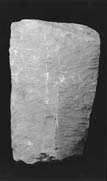
Object type: Part of grave-cover
Measurements: L. 46.5 cm (18.25 in) W. 29 > 22.5 cm (11.5 > 9 in) D. 14 cm (5.5 in)
Stone type: Grey, finely granular limestone, with numerous thin-shelled fossils seen in cross-section; one fairly large, concentrically striated bivalve; as Lincoln St Mark 21. Cathedral Beds, Lower Lincolnshire Limestone of Lincoln vicinity
Plate numbers in printed volume: Ill. 255
Corpus volume reference: Vol 5 p. 207-208
(There may be more views or larger images available for this item. Click on the thumbnail image to view.)
The central and greater part of a small tapered grave-cover, that is bowed in its longitudinal elevation like a hogback monument. It is undecorated except that its ridge is carved as a broad flat strip forming a panel that begins to splay out as if to form a hipped end at the head. There is no direct evidence of its development towards the foot, but a similar form may reasonably be anticipated (Stocker 1986a, fig. 61).
In form this cover has affinities with the hogback tradition. In other respects it is one of the large group of small-scale covers at St Mark's that fall in the general date range eleventh to thirteenth century. To have any connection with the hogback type it ought to date from the early end of that range.
