Select a site alphabetically from the choices shown in the box below. Alternatively, browse sculptural examples using the Forward/Back buttons.
Chapters for this volume, along with copies of original in-text images, are available here.


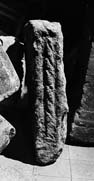
Object type: Grave-marker
Measurements: H. 70 cm (27.5 in) W. 55 > 51 cm (21.75 > 20 in) D. 17 cm (6.75 in)
Stone type: Yellowish grey (10YR 8/3) fairly coarse-grained oolite, with ooliths and pellets of 0.6 to 0.9mm diameter, close-set in a calcite matrix, some represented by empty sockets. There are few but large (10 to 30mm) shell fragments, and no obvious bedding. Upper Lincolnshire Limestone, Inferior Oolite Group [but not Ancaster or Barnack types].
Plate numbers in printed volume: Ills. 257–60
Corpus volume reference: Vol 5 p. 208-209
(There may be more views or larger images available for this item. Click on the thumbnail image to view.)
An upright rectangular grave-marker, complete except for the removal of the decorated surface on one broad face (C) and one narrow face (B). The stone was not originally tapered as it now measures; this is the effect of the redressing of the narrow face.The top is very slightly on a slant: this may suggest that like Lincoln (Cathedral) 2 it is a reused piece of Roman masonry.
A (broad): Decorated with a cable-moulded border that extends approximately 45 cm (17.75 in) down the arrises. Within, and with its upper outer arm abutting the upper border, is a double rectangular cross of type A1, one within the other, depicted through a pair of widely spaced incised lines. The inner cross though now damaged was a complete closed figure; the lower arm or stem of the outer cross fades against the edge of the roughly dressed surface that occupies the lower half of the stone. As with the similar evidence on the other monuments of this type, this indicates that the marker was intended to be set firmly earthfast. Across the centre of face A a rough horizontal incision of V-section has been cut to allow the stone to be fractured precisely for reuse as building material, as at TheDedication deleted.ethorpe St Helen 1.
B (narrow): This face has been dressed off flat for a secondary (or tertiary) use of the stone. It was presumably decorated like faces D and E.
C (broad): The surface has been completely and roughly removed. The remains of a cabled moulding on the common arris with D and the top show that the face had at least been decorated with a cabled border: it may have been identical with face A.
D (narrow) and E (top): Both decorated with cable-moulded borders and an additional cabled moulding occupying the central space.
This is one of the Lindsey group of closely similar rectangular markers found with a restricted distribution in Lincoln city and Lindsey (see Chapter V and Table 7A). The rather stubby-armed cross on this piece finds its best analogy in Lincoln city on Lincoln Cathedral 2 (Ills. 232–4), and the distinctively broad spacing of the incised double outline, which gives a clear impression of one cross within another, it shares with that piece from the Cathedral and Lincoln St Mary-le-Wigford 4 (Ill. 268), in contrast with the more strictly double outline examples in Lindsey at Gayton le Wold (Ills. 180, 184), Glentworth (Ill. 179) and Hackthorn 2 (Ills. 191, 193). It exactly parallels the piece from the Cathedral, too, in that the outline of the inner cross is completed instead of extending downwards to ground level. But it is the only one of the group to employ the device of filling the central space on the narrow faces and top with additional cabling.
