Select a site alphabetically from the choices shown in the box below. Alternatively, browse sculptural examples using the Forward/Back buttons.
Chapters for this volume, along with copies of original in-text images, are available here.


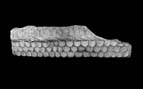
Object type: Incomplete grave-cover
Measurements: L. 85 cm (33.5 in) W. 23.5 cm (9.25 in) D.18 cm (7 in)
Stone type: Pale grey, slightly yellowish limestone, with a slightly silty, finely granular matrix with scattered ooliths, 0.8mm diameter pellets, and some bivalves, including a Modiolus; as Lincoln St Mark 5. Greetwell Member, Lower Lincolnshire Limestone of Lincoln vicinity
Plate numbers in printed volume: Ill. 408-410
Corpus volume reference: Vol 5 p. 284
(There may be more views or larger images available for this item. Click on the thumbnail image to view.)
A large part of a small, slightly tapered, coped grave-cover, decorated on its upper surface only. It is complete in length and survives to more than half its width, giving probable original dimensions of 32 > 23 cm (12.5 > 9 in).
A (top): The central ridge is decorated with cable moulding. Each sloping side is covered with deeply cut concave facets designed to produce the effect of overlapping wooden shingles on a roof (tegulation type 4 – Cramp 1991, fig. 7). The pattern is carefully and ably produced, except that the shingles on the incomplete slope are smaller and more numerous than on the near complete slope. This may indicate that the missing slope was shorter and the stone chosen did not allow a wholly symmetrical pattern.
B (side): Missing, broken.
C and E (ends): Incomplete, but undecorated original dressed surface survives.
D (side): Undecorated original dressed surface.
F (bottom): Undecorated original dressed surface with chamfer along the surviving arris.
Appendix A item (stones dating from Saxo-Norman overlap period or of uncertain date).
This cover appears to lie in the tradition of house-shaped monuments that extends from pre-Viking shrines through the varieties of Viking-age hogback monuments (Bailey 1980b, 85–100; Lang 1984). It differs from the hogbacks both in overall form and in decorative detail. It lacks the box-like body, the steep-pitched roof and characteristic bowed ridge line; it has no special treatment of the ends, whether of residual zoomorphic type or in the form found in the Trent Valley hogback tradition at Cranwell (no. 2, Ills. 109–20) or at Shelton in Nottinghamshire (Ills. 472–4). Its cable-moulded ridge and round-ended shingles are unlike Viking-age treatment of these features. It is, of course, possible in this case that the tradition of terminals may have been respected by separate markers at either end. Within the hogback tradition it is best viewed as a late example, which finds a parallel in a roofed cover at Fordwich in Kent ((—) 1929, 260, fig. 7; Rigold 1975, 131–2). In fact its small coped and tapered form falls comfortably in the local tradition of such monuments exhibited at St Mark's and the cabled border or rib is locally common.
The chamfered underside points to a sub-ground structure as seating for the cover and therefore a relatively elaborate grave.
