Select a site alphabetically from the choices shown in the box below. Alternatively, browse sculptural examples using the Forward/Back buttons.
Chapters for this volume, along with copies of original in-text images, are available here.


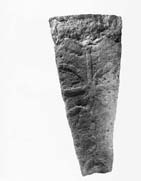
Object type: Grave-cover
Measurements: L. 118.5 cm (47 in) W. 55 > 22 cm (21.5 > 8.75 in) D. 20 cm (8 in)
Stone type: Yellow-brown fine-grained calcareous sandstone (0.1 to 0.2mm grain size), with thinly scattered ooliths, in places clustered; as Lincoln St Mark 5. Greetwell Member, Lower Lincolnshire Limestone of Lincoln vicinity
Plate numbers in printed volume: Ill. 412
Corpus volume reference: Vol 5 p. 284-285
(There may be more views or larger images available for this item. Click on the thumbnail image to view.)
A complete flat tapered grave-cover, decorated in low relief on the upper surface only.
A (top): The decoration comprises a rectangular cross with its cross-member across the middle of the cover. Each arm is elaborated in a U-form tridentine motif, which at the head end is missing because the surface has been completely removed.
B–F (sides, ends and bottom): Plain original faces.
Appendix A item (stones dating from Saxo-Norman overlap period or of uncertain date).
The U-form tridentine motif appears initially on pre-Conquest covers with interlace infilling as an elaboration of the foot of decorative crosses with the symbolism of a Calvary (Butler 1964, 119–21). As such it is a feature of covers in the Cambridge area (Fox 1920–1; Butler 1957) and the Barnack product with this type of foot at Lincoln Cathedral (no. 1, Ill. 230) is seen as an outlier of that tradition (Fox 1920–1, 24). The eleventh-century cover from Howell (Ill. 220) has this foot type but with no interlace, and in the products of the Barnack school the feature persists into the twelfth century (Butler 1964, 118–24). Here, too, later developments see the progressive elaboration of the central cross-bar with symmetrical geometric motifs (ibid.). St Mark 24 is clearly not, from its stone type, a Barnack product, but its most direct parallels are the Barnack pieces with tridentine decoration at head and foot as at Castor and Ufford and it is best seen as a derivative of that tradition. In this, and in its strongly tapered form, it most resembles Stallingborough 1 (Ills. 427–8) and dates from the same period as that cover.
