Select a site alphabetically from the choices shown in the box below. Alternatively, browse sculptural examples using the Forward/Back buttons.
Chapters for this volume, along with copies of original in-text images, are available here.


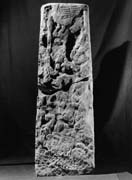
Object type: Part of cross-shaft [1]
Measurements: H. 87 cm (34.25 in) W. 29.3 > 23 cm (11.5 > 9.1 in) D. 20 > 18 cm (7.9 > 7.1 in)
Stone type: As no. 2
Plate numbers in printed volume: Ills. 408–11
Corpus volume reference: Vol 6 p. 143
(There may be more views or larger images available for this item. Click on the thumbnail image to view.)
A (broad) : The edge mouldings are modelled but very damaged, especially below the fracture. At the top a pot-bellied profile bird faces left. To its left is the point of a spear which runs up from below. The rest of the face has eroded away.
B (narrow) : The double edge moulding is modelled. The panel contains three-cord twist, gridded and in broad modelled strand. Just above the fracture are faint remains of a transverse moulding. The panel below contains a complete four-cord plait of seven registers. The strand is modelled and broad with deep hole-points.
C (broad) : Extremely worn, though some hole-points survive and a few loops of basket plait interlace in broad strand.
D (narrow) : Scabbled.
This shaft is from the Allertonshire workshop (Chap. VI, p. 44), as its bird is from the same template as those on Brompton 3C (Ill. 39), whilst the spear relates both to Brompton 3 and Sockburn 5 (Ills. 38, 1189: see Bailey 1978b, 184–5; Bailey 1980, 252; Lang 1986a, 248). In 1907 Collingwood noted red pigment on the bird. The warrior portrait is typical of a widespread predilection in Yorkshire for armed secular figures, for example at Otley (Cramp 1982, pl. 20b) and Middleton (Lang 1991, ills. 671, 677, 686, 688), which underlines the lay patronage of the monuments. The lost warrior of this piece was no doubt identical with those of Brompton 3 (Ill. 38) and Sockburn 5 (Ill. 1189; Cramp 1984, 137, pl. 131, 715).
