Select a site alphabetically from the choices shown in the box below. Alternatively, browse sculptural examples using the Forward/Back buttons.
Chapters for this volume, along with copies of original in-text images, are available here.


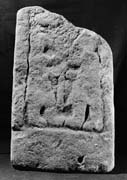
Object type: Shaft fragment [1]
Measurements: H. 49.8 cm (19.6 in) W. 33 > 30.5 cm (13 > 12 in) D. 17.5 > 16.5 cm (6.9 > 6.5 in)
Stone type: Coarse feldspathic gritstone with sub-angular grains. Brownish yellow (10YR 6/6). This is Millstone Grit (Namurian, Upper Carboniferous) from a Pennine source in the west of the region, commonly used for sculpture manufacture in Teesdale, Swaledale and Wensleydale.
Plate numbers in printed volume: Ills. 412–5
Corpus volume reference: Vol 6 p. 143-144
(There may be more views or larger images available for this item. Click on the thumbnail image to view.)
A (broad) : The edge moulding is broad and flat, and also forms a deep plain plinth at the base. Within the panel are two confronting profile figures, holding a staff between them. They wear knee-length kirtles and are animal-headed: the left a goat, the other a cockerel. A feature above them is now obscure.
B (narrow) : The edge mouldings and plinth are as on face A. The panel contains the lowest registers of a three- cord twist, whose middle strand is median-incised. The strand is flattish and picked.
C (broad) : The mouldings and plinth are as on face A. At the top right there is the corner of an upper panel with a fragment of strand, and part of a transverse moulding. Below is a square panel with a ring-knot in broad median-incised modelled strand. The ring is laced by return loops which at the right are modelled to form a kind of inner moulding to the panel.
D (narrow) : Mouldings are as on face A. The panel contains very worn closed circuit interlace, in median-incised strand. The lower three registers seem to be separate from those above where the pattern is very worn.
The ring-knot is common in much Anglo-Scandinavian decoration, though here it has been adapted to fill the panel after a misalignment of the ring. The animal-headed figures of face A are unique in Yorkshire, apart from Baldersby 1C (Ill. 6), and are one of Kirklevington's several Irish motifs. They are very probably the incubi associated with St Anthony, and an indication of the Celtic monastic tradition. The goat and cockerel heads are found on both the north and south crosses at Castledermot, Co. Kildare, where they flank the saint (Harbison 1992, I, 38, 39, II, figs. 103, 109) as well as at Moone in the same county (ibid., 155, fig. 518). The shaft was divided into small rectangular panels, a local feature.
