Select a site alphabetically from the choices shown in the box below. Alternatively, browse sculptural examples using the Forward/Back buttons.
Chapters for this volume, along with copies of original in-text images, are available here.


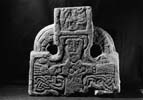
Object type: Cross-head [1] [2]
Measurements: H. 43.5 cm (17.1 in) W. 45 cm (17.7 in) D. 16 cm (6.3 in)
Stone type: As no. 1; possibly part of the same monument as no. 1
Plate numbers in printed volume: Ills. 438–41
Corpus volume reference: Vol 6 p. 148
(There may be more views or larger images available for this item. Click on the thumbnail image to view.)
The upper and lateral arms of a ring-head cross.
A (broad) : A type A11 cross with circular arm-pits, short squared arms and a longer upper limb whose top has been sawn off. The recessed ring (type a) lies close to the arm-pits and has a modelled edge moulding on each edge, flanking a run of curving step-pattern. The edges of the ring are bevelled. The cross has a modelled edge moulding. In the upper limb a panel of interlace has been defaced, though the strand seems to have been modelled. The panel is terminated by a transverse extension of the edge moulding. The centre and lateral limbs are filled by the upper half of a Crucifixion. The face is spade-shaped with 'hook and eye' features and slit mouth. The hair or nimbus is in the form of a flat cap filling the available space. Christ's hands are large and spread. Beneath the straight extended arms are closed circuit twists in modelled median-incised strand. Across Christ's body is the secondary inscription: 1698 WS.
B (narrow) : The modelled edge mouldings are narrow. The upper limb has median-incised interlace, with adhering mortar, abutting the ring which has a bevelled profile. The arm-tip has, within a frame moulding, median-incised closed circuit interlace partly concealed by mortar.
C (broad) : The edge mouldings and ring are as on face A. The upper limb retains the base of a panel with a row of tegula-like elements, worn at the right. A transverse moulding terminates the panel. There is a flattened boss almost in the centre of the cross, and in each arm interlace in broad median-incised strand with box-point terminals and asymmetrical long loops, the clumsily constructed pattern carved free-hand.
D (narrow) : The upper limb has narrow edge mouldings containing terminal loops of median-incised strand. The crest of the ring has a rough deeply gouged line along it. The arm-tip has a framed panel containing closed circuit interlace in modelled median-incised strand, of four registers.
E (top) : Sawn off.
This wheel-headed cross has many Irish characteristics. The relatively taller upper limb, once longer on this piece, the ring, and Christ's large spread hands are all to be found on the South Cross at Castledermot, Co. Kildare (Henry 1967, pl. 66; Harbison 1992, II, fig. 110), and the tight cap or halo on the North Cross at the same site (Henry 1967, pl. 70; Harbison 1992, II, fig. 101). Other pieces at Kirklevington display other features with parallels in the Castledermot area (see Chap. V, p. 37). Face A is more competently carved than face C and is laid out on a base grid of axial lines. The 'hook and eye' features are those of the figure on Kirklevington 2 (Ill. 399), though the cutting is much flatter here.
[1] The following are general references to the Kirklevington stones: Browne 1880–4, cx, cxii; Young 1882, 458; Allen and Browne 1885, 352; Frank 1888, 44; Bulmer 1890, 162; Hodges 1894, 195; (—) 1896–1905a, viii; Lofthouse 1896–8, 16; (—) 1899–1900b, 250; Morris, J. 1904, 228–9, 420; Collingwood 1908, 120; Page, W. 1923, 262; Morris, J. 1931, 229, 417; Elgee and Elgee 1933, 217, 248; Mee 1941, 136; Pevsner 1966, 221; Morris, C. 1976a, 143–4; Brown, M. 1979, 44; Horton 1979, 195; Bailey 1980, 252, 255, 265; Cramp 1984, 30; Lang 1991, 42, 214; Daniels 1995, 81; Stocker 2000, 200–3.
[2] The following is an unpublished manuscript reference to no. 15: BL Add. MS 37552 no. XIV, items 647–8 (Romilly Allen collection).
