Select a site alphabetically from the choices shown in the box below. Alternatively, browse sculptural examples using the Forward/Back buttons.
Chapters for this volume, along with copies of original in-text images, are available here.


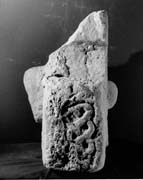
Object type: Part of cross-head
Measurements: H. 46 cm (18.1 in) W. 45.2 cm (16.7 in) D. 26 > 14.5 cm (10.2 > 5.7 in)
Stone type: Medium-grained, well bedded, deltaic sandstone. Pale brown (10YR 6/3). Stone provenance probably as no. 2
Plate numbers in printed volume: Ills. 488–92
Corpus volume reference: Vol 6 p. 156
(There may be more views or larger images available for this item. Click on the thumbnail image to view.)
A (broad) : A type A10 cross-head, it has free arms with rounded arm-pits and squared tips. The plain flat moulding expands at the lateral arm-tip. In this lateral arm is an angular pattern E loop in a neat strand, which, perhaps thanks to dressing, takes on the appearance of a twin-link joined to the upper limb. In the centre is a well modelled human face in high profile. It has pellet eyes and a ridged nose. The mouth is a horizontal incision. The area around the head has been dressed back.
B (narrow) : The arm-tip has a plain perimeter frame enclosing a closed circuit pattern of two bent link elements in narrow strand. Mortar adheres to this face.
C (broad) : The edge moulding is as on face A. In the centre is a large domed boss which is surrounded by a modelled strand that links the interlace in the arms. The pattern in the complete arm is a pattern F knot extended by one extra stage. The terminals of the loops at the centre of the cross are all of the symmetrical type, though the upper limb has a simple pattern E element.
D (narrow) : Broken away.
The plastic, highly modelled human head is very rare among cross-heads in Yorkshire. The dressing of the stone around and below it may have removed shoulders, but there is little likelihood of it being a Crucifixion since the cross-arms were filled with interlace. It should be compared with Bromfield 3, Cumberland (Bailey and Cramp 1988, 87, ills. 177–9), though the Lythe head wears no hat, and possibly with the free-armed cross from Durrow, Co. Offaly, in Ireland where a standing figure's head occupies a similar position and the cross-arms carry interlace (Harbison 1992, I, 82–3, II, fig. 259). It is possible that the dressed area was coated with gesso and painted. There is no nimbus and the figure may not have been intended for Christ. Collingwood thought the carving late, and indeed the cross shape and the interlace do occur in an Anglo-Scandinavian context. He calculated that the radius of the cross was 12 inches (30.5 cm).
