Select a site alphabetically from the choices shown in the box below. Alternatively, browse sculptural examples using the Forward/Back buttons.
Chapters for this volume, along with copies of original in-text images, are available here.


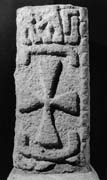
Object type: Grave-marker or shaft fragment
Measurements: H. 56 cm (22 in) W. 27.5 > 24.3 cm (10.8 > 9.6 in) D. 16 > 14.5 cm (6.3 > 5.7 in)
Stone type: As Masham 1 (St Mary), but micaceous with quartz pebbles up to 15mm in size. This shaft has been burnt on top, the original yellow colour (10YR 7/4) assuming a reddish brown (2.5YR 5/4–5/6) colour.
Plate numbers in printed volume: Ills. 639–42
Corpus volume reference: Vol 6 p. 174
(There may be more views or larger images available for this item. Click on the thumbnail image to view.)
A (broad) : A slab-like section, damaged on the left; on the right is a bold cable moulding. At the top left are the remains of a profile human figure, the feet pointing to the centre, crudely cut. There is, perhaps, an extended hand. In the centre another figure faces left with extended arm; the lower part of the head survives. On the right are two interlocking L-shaped fillers. Below is a panel flanked by horizontal fillers with turned ends at both top and bottom. Between them is a large, hacked Maltese cross (type B6).
B (narrow) : The edge mouldings are bold cables. Within the long panel crude undulating serpents lie alongside each other.
C (broad) : The edge mouldings are cabled. Within the panel down each side is a row of interlocking L-shaped fillers. Running down the centre is a double row of pellets; four registers survive.
D (narrow) : Scabbled, but remains of edge moulding.
Only the human figures have any appearance of Anglo-Scandinavian work, and they are roughly cut. The simplicity of the fillers offers no clue to date, but the Maltese cross is common in the North Riding and co. Durham on early medieval coped grave-covers (e.g. Ryder 1985, pl. 29, no. 28). This could be an early Romanesque piece, though there are no analogues for it.
