Select a site alphabetically from the choices shown in the box below. Alternatively, browse sculptural examples using the Forward/Back buttons.
Chapters for this volume, along with copies of original in-text images, are available here.


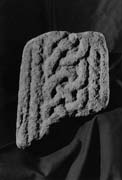
Object type: Shaft fragment [1]
Measurements: H. 32.5 cm (12.7 in) W. 25 > 23.2 cm (9.8 > 9.1 in) D. 19.5 > 18.3 cm (7.7 > 7.2 in)
Stone type: Very coarse feldspathic Millstone Grit with very angular grains. Light yellowish brown (10YR 6/4). Stone provenance as Wensley 1 (Holy Trinity)
Plate numbers in printed volume: Ills. 867–70
Corpus volume reference: Vol 6 p. 222
(There may be more views or larger images available for this item. Click on the thumbnail image to view.)
A (broad) : Broken at top and bottom. The outer edge moulding is flat and within it is an inner cable moulding. Within the panel is part of a run of simple pattern F interlace with opposed Carrick bends. The strand is modelled.
B (narrow) : The edge moulding is broad and flat, much worn on the right hand. Within the panel is a tightly coiled scroll in narrow modelled strand. At its lower corner are pellets. Below is part of a trail with volute tip, much damaged.
C (broad) : Very worn. The narrow edge moulding is flat. Within the panel is tightly woven six-cord plain plait, its strand 1 inch wide.
D (narrow) : Damaged and worn. The right-hand edge moulding survives. Within the panel is the remains of simple pattern F interlace.
The tight scroll of face B may be a serpent, like that of Forcett 1 (Ill. 251). The tight weave of the interlace and use of pellets are typical Anglo-Scandinavian features.
