Volume 6: Northern Yorkshire
Select a site alphabetically from the choices shown in the box below. Alternatively, browse sculptural examples using the Forward/Back buttons.
Chapters for this volume, along with copies of original in-text images, are available here.
Current Display: Wensley 04, Yorkshire North Riding


Overview
Object type: Shaft fragment(?) [1]
Measurements: L. 55.5 cm (22 in) W. 31 cm (12 in) D. Built in
Stone type: As no. 3, but the colour (light yellow brown, 10YR 6/4) is partly masked by reddish algae growth, causing discolouration.
Plate numbers in printed volume: Ill. 872
Corpus volume reference: Vol 6 p. 222-223
(There may be more views or larger images available for this item. Click on the thumbnail image to view.)
Present Location
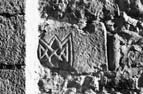
Built into the north wall of the nave, by the east buttress, horizontally, about 3 m above ground. (Not 'built in on the north of the tower', as claimed by Collingwood (1907, 408): Adcock (1974, 154) thought that the piece was lost.)
Evidence for Discovery
None
Church Dedication
Holy Trinity
Present Condition
Only one face visible; broken but crisp
Description
On the right is a broad roll moulding, separated from an uncarved area by a deep groove. Beyond this is a closed circuit interlace pattern whose bends are sharp angles and which consists of two laced figure-of-eight forms with bar terminals. Rolled edge mouldings are integral with the pattern, but the lower part is damaged. The strand is narrow modelled and deeply cut.
Discussion
The angularity of the pattern is very unusual (Adcock 1974, 133, 368). Its use of long diagonals and the very open layout of the interlace does however point to a pre-Viking date. The uncarved area does not appear to be a tenon, as Collingwood thought (1907, 408).
Date
First half of ninth century
References
Collingwood 1907, 272, 288, 289, 294, 408, fig. m on 409; McCall 1910, 159; Collingwood 1912, 128; Collingwood 1915, 270; Adcock 1974, 133, 154n; Lang 1991, 169; White 1997, 47
Endnotes
[1] The following are general references to the Wensley stones: Barker 1854, 183; Barker 1856, 183; Whellan 1859, II, 439; Hodges 1894, 195; (—) 1906–11a, xxxiv; (—) 1908b, 468; Bolton 1915–16, 228; Morris, J. 1931, 397, 417; Elgee and Elgee 1933, 251; Mee 1941, 249; Morris, C. 1981, 234; White 1997, 47. In November 1915 a skeleton with its head to the west was discovered in Wensley churchyard, together with a late Anglo-Saxon sword, knife, spearhead and sickle (Bolton 1915–16, 228–30; Wilson, D. 1965, 41–2). The burial was 4 ft 6 in below the surface, and adjacent to mortared stone foundations running north–south. Wilson dates the sword to the late ninth century. (Eds.)