Volume 6: Northern Yorkshire
Select a site alphabetically from the choices shown in the box below. Alternatively, browse sculptural examples using the Forward/Back buttons.
Chapters for this volume, along with copies of original in-text images, are available here.
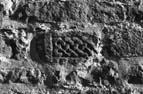
Current Display: Wensley 05, Yorkshire North Riding


Overview
Object type: Shaft fragment [1]
Measurements: L. 32 cm (12.6 in) W. 16.5 cm (6.5 in) D. Built in
Stone type: As Wensley 1 (Holy Trinity)
Plate numbers in printed volume: Ill. 871
Corpus volume reference: Vol 6 p. 223
(There may be more views or larger images available for this item. Click on the thumbnail image to view.)
Present Location
Built into the exterior north wall of the tower, horizontally, 1.8 m above ground
Evidence for Discovery
None. The tower was rebuilt in 1719 (Pevsner 1966, 382).
Church Dedication
Holy Trinity
Present Condition
Only one face visible
Description
A broad plain perimeter moulding forms three sides of a panel of four-cord plait, resolved in box points at one end. The strand is narrow and modelled; the hole points drilled. Above the transverse moulding the surface slopes away to form the neck of the cross.
Discussion
Part of the narrow face of a cross-shaft. The density of the interlace and its closed circuit indicate its Anglo-Scandinavian character. The drilled hole-points are a feature of the Allertonshire workshop (Chap. VI, pp. 44–7), which used the device to lay out a regular grid.
Date
Mid ninth to mid tenth century
References
?Speight 1897, 381; Collingwood 1907, 272, 408, fig. n on 409; McCall 1910, 159; Collingwood 1912, 128
Endnotes
[1] The following are general references to the Wensley stones: Barker 1854, 183; Barker 1856, 183; Whellan 1859, II, 439; Hodges 1894, 195; (—) 1906–11a, xxxiv; (—) 1908b, 468; Bolton 1915–16, 228; Morris, J. 1931, 397, 417; Elgee and Elgee 1933, 251; Mee 1941, 249; Morris, C. 1981, 234; White 1997, 47. In November 1915 a skeleton with its head to the west was discovered in Wensley churchyard, together with a late Anglo-Saxon sword, knife, spearhead and sickle (Bolton 1915–16, 228–30; Wilson, D. 1965, 41–2). The burial was 4 ft 6 in below the surface, and adjacent to mortared stone foundations running north–south. Wilson dates the sword to the late ninth century. (Eds.)