Volume 6: Northern Yorkshire
Select a site alphabetically from the choices shown in the box below. Alternatively, browse sculptural examples using the Forward/Back buttons.
Chapters for this volume, along with copies of original in-text images, are available here.
Current Display: Wensley 06, Yorkshire North Riding


Overview
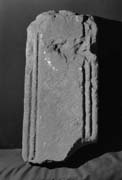
Object type: Shaft fragment [1]
Measurements: H. 57 cm (22.5 in) W. 28 > 24.5 cm (11 > 9.6 in) D. 17.5 > 16 cm (7 > 6.3 in)
Stone type: As Wensley 1 (Holy Trinity)
Plate numbers in printed volume: Ills. 873–6
Corpus volume reference: Vol 6 p. 223
(There may be more views or larger images available for this item. Click on the thumbnail image to view.)
Present Location
Lying loose in the graveyard east of the south porch
Evidence for Discovery
None. In 1907 in the south porch; in 1910 in the vestry. Not found by the author; rediscovered by D.C. in 1999.
Church Dedication
Holy Trinity
Present Condition
Broken and worn
Description
A tapering shaft, broken at both ends. All four faces are edged with a double roll moulding. On the narrow faces the outer moulding is distinctly broader. The surfaces are plain but smoothly dressed.
D.C.
Discussion
The plainness and double roll moulding might suggest an early date by analogy with carvings at Whitby (q.v.) or York Minster (Lang 1991).
J.L.
Date
Possibly eighth to ninth century
References
Collingwood 1907, 408 (1); McCall 1910, 159; Collingwood 1912, 128; Collingwood 1915, 271
Endnotes
[1] The following are general references to the Wensley stones: Barker 1854, 183; Barker 1856, 183; Whellan 1859, II, 439; Hodges 1894, 195; (—) 1906–11a, xxxiv; (—) 1908b, 468; Bolton 1915–16, 228; Morris, J. 1931, 397, 417; Elgee and Elgee 1933, 251; Mee 1941, 249; Morris, C. 1981, 234; White 1997, 47. In November 1915 a skeleton with its head to the west was discovered in Wensley churchyard, together with a late Anglo-Saxon sword, knife, spearhead and sickle (Bolton 1915–16, 228–30; Wilson, D. 1965, 41–2). The burial was 4 ft 6 in below the surface, and adjacent to mortared stone foundations running north–south. Wilson dates the sword to the late ninth century. (Eds.)