Select a site alphabetically from the choices shown in the box below. Alternatively, browse sculptural examples using the Forward/Back buttons.
Chapters for this volume, along with copies of original in-text images, are available here.


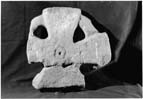
Object type: Part of cross-head [1] [2]
Measurements: H. 47 cm (18.5 in) W. 46 cm (18 in) D. 12 > 7.5 cm (4.7 > 3 in)
Stone type: As Wensley 3 (Holy Trinity)
Plate numbers in printed volume: Ills. 877–80
Corpus volume reference: Vol 6 p. 223-224
(There may be more views or larger images available for this item. Click on the thumbnail image to view.)
Incomplete cross-head, type B8, with a recessed ring of type 1 (a) surviving between the upper arms. The armpits are pierced. The lower arm broadens out above the missing shaft.
A (broad) : Plain, apart from an incised ring and dot at the centre of the head, and traces of a grooved edge moulding on the surviving transverse arm. The ring is undecorated.
B (narrow) and E (top) : Plain.
C (broad) : Plain, apart from a ring and dot at the centre, more faintly incised than on face A.
D (narrow) : Broken.
This type of plain ring-headed cross may be compared with Lythe 8 (Ills. 494–5) and Sockburn 12 (Cramp 1984, 140, pl. 140, 749–50), and is probably late in the ring-head series.
[1] The following are general references to the Wensley stones: Barker 1854, 183; Barker 1856, 183; Whellan 1859, II, 439; Hodges 1894, 195; (—) 1906–11a, xxxiv; (—) 1908b, 468; Bolton 1915–16, 228; Morris, J. 1931, 397, 417; Elgee and Elgee 1933, 251; Mee 1941, 249; Morris, C. 1981, 234; White 1997, 47. In November 1915 a skeleton with its head to the west was discovered in Wensley churchyard, together with a late Anglo-Saxon sword, knife, spearhead and sickle (Bolton 1915–16, 228–30; Wilson, D. 1965, 41–2). The burial was 4 ft 6 in below the surface, and adjacent to mortared stone foundations running north–south. Wilson dates the sword to the late ninth century. (Eds.)
[2] The following is an unpublished manuscript reference to no. 7: BL Add. MS 37552 no. XIV, item 808 (Romilly Allen collection).
