Select a site alphabetically from the choices shown in the box below. Alternatively, browse sculptural examples using the Forward/Back buttons.
Chapters for this volume, along with copies of original in-text images, are available here.


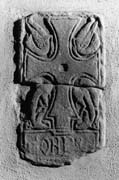
Object type: Part of grave-marker [1]
Measurements: H. 41.5 cm (16.3 in) W. 23 cm (9.1 in) D. Built in
Stone type: Medium-grained, micaceous, feldspathic Millstone Grit. Very pale brown (10YR 7/3) to light yellowish brown (10YR 6/4). Stone provenance as Wensley 1 (Holy Trinity)
Plate numbers in printed volume: Ills. 883, 885
Corpus volume reference: Vol 6 p. 224-226
(There may be more views or larger images available for this item. Click on the thumbnail image to view.)
A (broad) : A narrow, finely rolled edge moulding frames the sides and top of the slab. The panel is filled by a type B9 cross with widely curved arm-pits and splayed arms. It has a narrow perimeter moulding, its upper and lower limbs are longer, and at its centre is a small square recess. The foot of the cross is given a tenon-like feature, and the perimeter moulding at the base of this stem interlocks with the frame of an inscribed panel below it. In the spaces above the lateral arms is a bird in each corner: each is a mirror image of the other. The birds have slender legs, lobed feet, wedge-shaped tail and long pointed wings which slant diagonally upwards. The necks are long and the head is laid along the back. Below each arm is a quadruped with elongated body and pear-shaped thighs. The head is thrown back (though the left-hand one is broken away), with a square jowl. The tail is looped in a Stafford knot with a volute on the tip. One foreleg and one hindleg are crossed. Below the cross is a horizontal panel within a narrow modelled frame interlocked with the edge mouldings of the cross-stem.
Inscription The inscription is set within a panel with a slightly raised border and probably consisted of seven letters in a single line. The letters, which are about 5 cm high, are carved in low relief. They are taller than those on Wensley 9 and their stems are more slender (the stem of N is about 0.4–0.5 cm across). The surface of the stone is very abraded at either end of the text. The inscription, which is in Insular decorative capitals, can be transcribed as follows:
The first five letters are legible. Following them there are slight traces of two verticals. These are compatible with the final -ID shown in early illustrations, which appear to have been made before the damage to either end of the inscription was so advanced (e.g. Haigh 1845, fig. on p. 196). The text can then be reconstructed with reasonable certainty as DONFR[ID] (see discussion of lettering below; Okasha 1971, 120). This is presumably a personal name, perhaps a form of the Old English masculine name Dōmfriþ (Sweet 1885, 161; Searle 1897, 168).
The lettering is an elegant example of Insular decorative capitals (Higgitt 1994). The letters are tall and compressed and consist of even strips terminating in wedged serifs. Although worn, the first letter was clearly a rectangular version of the Insular half-uncial D. The squared 'bowl' was slightly open at the top right, and the short stroke that descends into the bowl from the horizontal ends in a worn but distinct wedged serif. Similar rectangular variations on the half-uncial D can be seen in inscriptions at Hartlepool and Auckland St Andrew and possibly at Wycliffe (Okasha 1971, pls. 11, 45, 46 and 47; Cramp 1984, pl. 3.6; this volume, Ill. 1099), and in the display script of an eighth-century manuscript at St Gall (Cod. 1395, p. 426: Alexander 1978, ill. 261). The second letter is a sharply pointed lentoid O. There are a few parallels among Anglo-Saxon inscriptions, including that at Skelton (see this volume, Ill. 744), but only the compressed letter at the end of the Jarrow 16 text matches its narrowness (Okasha 1971, nos. 63, 110, 116, 150; id. 1983, no. 175). The N and the F, with its arched upper stroke and low-slung cross-stroke, are both derived from the Insular half-uncial letters and can be matched in the display script of Insular manuscripts as well as in Insular inscriptions (N1 and F1 in Higgitt 1994, 219–20, 226, 228). The R appears to have been the capital (or uncial) form that is common in the Insular half-uncial text and display script (R1 in Higgitt 1994, 229–30). The remainder of the inscription is less certain. Context and the early illustrations show that the first of two partially surviving verticals was an I. Traces of a second vertical can just be made out close to the right-hand framing strip. The position of this vertical and the early illustrations make it probable that this belonged to a second D, similar to the rectangular version of half-uncial letter seen at the start (Haigh 1845, fig. on p. 196; and cf. Gough 1806, pl. XVII, fig. 4; Whitaker 1823, fig. on p. 371).
B–E: Built in without being recorded.
This name-stone differs from the Bernician series in that both its cross and epitaph are cut in relief, and the spaces are filled with animal ornament. It is by far the most decorative of its kind in Northumbria, apart from the lost slab from Knells, Cumberland, which it closely resembles (Bailey and Cramp 1988, 126, ills. 425–6). The birds and quadrupeds are accommodated to their spaces and it is unlikely that they have any iconographic significance, despite the confronting birds of Catterick 1 (Ill. 111) and Ripon (Collingwood 1915, 235, fig. g). A similar cross in relief is found on the shaft fragment York Minster 25 (Lang 1991, 67, ill. 105), which marks a transition from the incised tradition. A grave-marker, York Minster 29 (ibid., 68–9, ill. 121), has a similar cross form with similar spaces around it, but it is of much cruder workmanship. The central square recess very probably once contained an appliqué or semi-precious stone, like the free-standing cross-head Lastingham 4 and the plaque Middleton 9 (ibid., 169, ills. 582, 583; 187, ill. 694) in the east of the county. That would put it in an eighth- or early ninth-century milieu, as would the attenuated beasts with the volute tip to the tail (see Chapter V), though rectangular settings can occur much earlier; for example, Lindisfarne 33 (Cramp 1984, pl. 200, 1128), and Lindisfarne 22 and 24 which have a circular setting in the Wensley position (ibid., pls. 199, 1111 and 200, 1119).
Inscription Several early Northumbrian memorial stones, including Wensley 9 (Ill. 884), take the form of a cross-decorated slab inscribed with a personal name in Roman or runic characters and no other text (Okasha 1971, pls. 45, 48–50, 52, 75–6, 80, 91, 121; id. 1992, pl. IVa; Page, R. 1999, figs. 11, 12). Wensley 8 is unusual in placing the name in a panel at the foot of the cross rather than in the fields on either side. The reason for this may simply be that these fields were not available because it had been decided to fill them with carvings of birds and quadrupeds. Carvings of birds seem in a similar way to have displaced a name to the upper border on the lost cross-decorated slab at Knells, Cumbria (Bailey and Cramp 1988, 126, ills. 425–6). Placing the name at the foot of the cross may perhaps also have been meant to recall the act of humble prostration at the foot of the cross (cf. Higgitt 1986b, 142–3).
The most unusual aspect of the inscriptions on the two slabs at Wensley is that they were carved in relief rather than, as usual, incised. This is a more laborious technique but has the effect of relating the lettering to the relief of the rest of the carving. It also allows the letter-cutter to produce lettering with the broad strokes found in the display script of some Insular manuscripts of around the second half of the eighth century, such as the Stockholm Codex Aureus, the Rawlinson and St Gall Gospels and some pages of the Book of Kells (Alexander 1978, ills. 152, 196, 201, 242, 253). Inscriptions carved in relief on stone are very rare in early medieval Insular epigraphy, the only other clearly early examples being from Tarbat in Scotland and Bealin in Ireland, probably datable respectively to the later eighth or early ninth century and to c. 800 (Higgitt 1982, 315–17; Carver 1998, 33–5). The technique, which had a vogue in sixth-century Constantinople, may have found its way to the Insular world by way of Rome, where it was employed in work commissioned by the Greek pope, John VII (705–7) (Higgitt 1982, 316–17). It might on the other hand have had an independent Insular origin in the imitation in stone of raised-letter inscriptions in repoussé metalwork such as the eighth-century examples on the silver cladding of the portable altar of St Cuthbert now at Durham, on the Mortain casket, or on the York helmet (Okasha 1971, 69–70, 102, pls. 35b, 35c, 93; id. 1992, 58–60, pl. VIIIb; Webster and Backhouse 1991, 60–2, 134–5, 175–6). The Newent slab, Gloucestershire, which also carries relief lettering, probably dates from around the year 1000. The influence of metalwork that has been detected in aspects of the sculpture of the slab may also explain the technique of the lettering (Zarnecki 1953; Okasha 1971, 102–3 and pls. 94a–d; Bailey 1996a, 122).
The elegant Insular decorative capitals suggest contact with an ecclesiastical centre that used such lettering for the display script of its manuscripts, probably sometime in the second half of the eighth or early ninth century.
