Select a site alphabetically from the choices shown in the box below. Alternatively, browse sculptural examples using the Forward/Back buttons.
Chapters for this volume, along with copies of original in-text images, are available here.


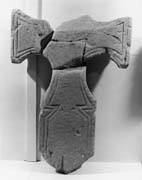
Object type: Part of cross-shaft and -head, in six joining pieces [1]
Measurements: H. 77.5 cm (30.5 in) W. (shaft) 26 cm (10.2 in); (cross-arms) 55.4 cm (21.8 in); (neck) 15 cm (5.9 in) D. (shaft) 16.5 cm (6.5 in); (head) 15 cm (5.9 in)
Stone type: Medium-grained, well sorted, feldspathic, micaceous sandstone. Very pale brown (10YR 7/4). Deltaic sandstones of the Saltwick Formation, Aalenian, Middle Jurassic, from the Aislaby Quarries, Eskdale, near Whitby
Plate numbers in printed volume: Ills. 897–9
Corpus volume reference: Vol 6 p. 231
(There may be more views or larger images available for this item. Click on the thumbnail image to view.)
A (broad) : The top of the shaft and two limbs of the cross survive. The cross-head is of type A10 with wide curves to the arm-pits and squared tips to the expanding arms. The plain surface is outlined by a double roll moulding: on the cross-head both beads are 1.8 cm wide, but on the shaft the outer one is 2.6 cm and the inner 1.8 cm. Within the mouldings the tips of the cross-arms are angled. Just below the curved armpits the mouldings turn in sharply to form a narrow junction between a splayed lower arm defined by the mouldings and the rest of the shaft. At the same level as the indented mouldings the sides of the shaft are nicked. The rest of the face is plain, and very smoothly dressed.
B (narrow) : Plain and smoothly dressed. A few centimetres below the curve of the arm-pit is a deeply incised horizontal groove.
C (broad) : As face A. Not currently visible.
D (narrow) : As face B.
The restrained, almost ascetic quality of this cross is typical of the early series of monuments from the site (Chap. VI, pp. 39–40). The widely curving arm-pits and straight tipped arms are common features here (Fig. 10, p. 40). This particular cross uses roll mouldings to convey the appearance of an equal-armed cross surmounting a shaft, with the horizontal grooves on the narrow faces reinforcing that impression. The smooth dressing may have been accomplished by an abrasive stone. The condition of this fine dressing suggests that the cross originally stood indoors, but not against a wall since faces A and C are both carved. The reconstruction of the cross by Peers and Radford (1943, fig. 1) differs from that of the current museum display where it now has two lateral arms and no upper limb.
