Select a site alphabetically from the choices shown in the box below. Alternatively, browse sculptural examples using the Forward/Back buttons.
Chapters for this volume, along with copies of original in-text images, are available here.


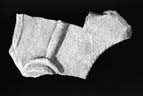
Object type: Cross-head fragment [1]
Measurements: L. 26.5 cm (10.4 in) W. 31.8 > 13 cm (12.5 > 5.1 in) D. 8.2 cm (3.2 in) Depth of boss 1.8 cm (0.7 in)
Stone type: [Sandstone]
Plate numbers in printed volume: Ills. 961–3
Corpus volume reference: Vol 6 p. 240-241
(There may be more views or larger images available for this item. Click on the thumbnail image to view.)
Parts of one broad and two narrow faces of the cross-head survive, but all other faces have been cut away.
A (broad) : The head was outlined by a worn cable moulding and inner roll moulding, and from the wide curve of the arm the complete shape may have been like no. 18. The background surface of the arm is plain and smoothly finished, and in the centre is the remnant of a deep boss surrounded by a bold ring of cable patterning to which a rectangular bar is attached.
B and D (narrow) : Plain but edged by cable moulding on the arris and an inner square-sectioned roll moulding.
C (broad) : Broken away.
This newly discovered cross fragment is quite unlike the early Plain Cross group which includes so many of the Whitby monuments (pp. 39–40), but finds some parallel in what survives from Whitby in its likeness to the arm no. 18 (Ills. 958–60) which has a similar outline moulding and shape of head. The central motif, however, is unique on the site and seems to be a 'spine-and-boss' – a feature which has a wide circulation between north Yorkshire and Cumbria (see Chapter VI). The early types at centres such as Ripon and Northallerton copy metalwork models, but this bold carving seems to introduce the later tradition, with prominent bosses in the centre of the head and the ends of the arms, and the 'spine' as a straight rather than a tapering or enclosed bar; but here this is not enclosed to form the 'lorgnette' (see Collingwood 1913a, fig. on 170; Collingwood 1927a, fig. 116). In type the Whitby arm is most like that from Forcett (no. 1, Ill. 250), but is much more assuredly carved and must be earlier. In fact it seems to form a missing link between early spine-and-boss examples such as Northallerton 5 (Ills. 672–3) and later forms of the lorgnette motif. It is an important reminder that Whitby remained an influential and creative centre throughout the pre-Viking period.
[1] The following are general references to the Whitby stones: Hood 1927, 38, 45, 49; Kendall 1932, 9–10, 26–7, 28; Peers and Radford 1943, 33–40; Clapham 1952, 11; Wilson, D. 1964, 9; Cramp 1965b, 4; Fellows-Jensen 1972, 218; Cramp 1976a, 228; Cramp 1976b, 455–7; Rahtz 1976, 460; Cramp 1978a, 7; Bailey 1980, 81, 82; Okasha 1983, 118; Cramp 1984, 9, 79, 109, 180, 222; Higgitt 1986b, 130–1, 134, 148; Bailey and Cramp 1988, 55, 56, 85, 154; Cramp 1989, 223; Lang 1989a, 67; Lang 1990a, 2–3; Higgitt 1991, 45; Lang 1991, 24, 109, 138, 139; Cramp 1992, 8, 24, 107, 224, 252; Okasha 1992, 84; Cramp 1993, 68–9, 71; Fellows-Jensen 1995, 177; Higgitt 1995, 229–36; Rahtz 1995, 7–8; Bailey 1996a, 50–1, 111; Hawkes 1999b, 403, 410–16; Karkov 1999, 133–4; Stocker 2000, 200; Stopford 2000, 102, 104.
[2] Information and measurements by courtesy of Sarah Jennings, English Heritage.
