Select a site alphabetically from the choices shown in the box below. Alternatively, browse sculptural examples using the Forward/Back buttons.
Chapters for this volume, along with copies of original in-text images, are available here.


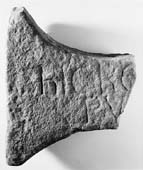
Object type: Cross-arm [1]
Measurements: L. 18.8 cm (7.8 in) W. 23.5 cm (9.3 in) D. 11.8 > 10.5 cm (4.4 > 4.1 in)
Stone type: Medium-grained deltaic sandstone containing mica and feldspar; the grains are well sorted and sub-rounded. Prominent cross-bedding parallel to the lettered face, which has been subject to slight soft bed weathering. Very pale brown (10YR 7/3). Stone from a local cliff source in the Saltwick Formation, Aalenian, Middle Jurassic, close to the abbey site (quarry may now have been destroyed by coastal erosion).
Plate numbers in printed volume: Ills. 964–9
Corpus volume reference: Vol 6 p. 241-242
(There may be more views or larger images available for this item. Click on the thumbnail image to view.)
Transverse left arm of a cross with widely curving arm-pits, type B10.
A (broad) : No decorative features. Inscribed.
Inscription This fragment carries the opening letters of two lines of a horizontally set incised inscription. The letters were originally quite deeply cut but are now very worn, probably apparently by weathering. The letters are capitals of about 4 cm in height and the inscription may be transcribed as follows:
The language was clearly Latin. In this context the first two words (HIC RE—) can be reconstructed with near certainty as the opening of a Latin memorial formula: HIC RE[QVIESCIT] ('Here rests'). The PV— of the second line may, as suggested by Radford (Peers and Radford 1943, 44), have formed part of a phrase such as in (hoc) sepulchro ('in this tomb'). If, as is probable, HIC was the first word of the inscription, the inscription opened without an introductory cross. It is uncertain whether the inscription continued in further lines below the present second line.
As far as it can now be judged, the remaining lettering consisted of neatly executed mixed capitals. C, I, P, R and V follow their normal 'Roman' forms. The bowls of the R and probably also the P seem to have been open at the bottom. The two non-capital forms are round E, a form resembling the uncial letter, and an H with a right-hand stroke that curls in gently towards the base rather than remaining vertical and should also therefore probably be thought of as uncial rather than half-uncial. In their present, weathered condition the letters show no perceptible serifing. A slight depression between HIC and RE— may be the weathered remnant of a mid-line point.
B (neck) : Broken.
C (broad), E and F (upper and lower) : Roughly dressed.
D (end) : Plain and worn.
One of the Plain Cross group, but the subgroup in which there are no mouldings and the inscription is the important item.
Inscription No. 20 belongs to a small group of apparently plain stone crosses found at Whitby with inscriptions in one or more horizontal lines carved on their heads (cf. Whitby 21, 22, 23 and perhaps also 24 and 26). This characteristic Whitby form has only rarely been found elsewhere, with examples at Bewcastle, Carlisle, Dewsbury and York (Higgitt 1995, 230).
The inscription marked the cross out as a funerary memorial, if, as is almost certain, it opened with the words Hic requiescit. This formula originated on the Continent (e.g. Cabrol and Leclercq 1925, cols. 2372–5; Knight 1999, 107–8) and is known from early Northumbrian inscriptions at Monkwearmouth and probably also at Hartlepool and recorded by Bede in epitaphs at Ripon and Canterbury (Bede 1969, 144–5, II.3 and 528–9, v.19; Okasha 1971, nos. 44, 92; Higgitt 1995, 232, 234). If it is correct on the basis of the 'PV—' of the second line to reconstruct the full form of the opening as 'Hic requiescit in sepulchre ...', this may be compared with the perhaps early eighth-century tombstone at Monkwearmouth (Hic in sepulchro requiescit corpore X). The inscription on Whitby 20 seems to have begun without an introductory cross, as indeed did that on the Monkwearmouth tombstone (Okasha 1971, 101).
The indentation of the second line in relation to the first suggests that the lettering may have been laid out symmetrically with two (and perhaps more) lines of different lengths centred about the vertical axis of the cross.
What is left of the lettering (seven letters) is composed of mixed capitals combining 'Roman' capitals with uncial letters. The general effect of this lettering, and the absence of geometric and Insular forms, can be compared with a more 'Roman' strain seen in a number of Northumbrian inscriptions, particularly at Monkwearmouth and Jarrow but also at York. These comparisons would support a late seventh- or eighth-century dating for the lettering (Higgitt 1995, 233).
