Select a site alphabetically from the choices shown in the box below. Alternatively, browse sculptural examples using the Forward/Back buttons.
Chapters for this volume, along with copies of original in-text images, are available here.


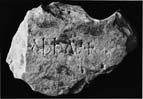
Object type: Part of cross-head [1]
Measurements: H. 31.2 cm (12.3 in) W. 43 cm (16.9 in) D. 10.5 > 10 cm (4.1 > 3.9 in)
Stone type: Fine-grained micaceous sandstone, recognisable as having been distinctly burnt. Very pale brown burnt to a red colour in patches (2.5YR 4/4). Stone provenance as Whitby 1 (abbey, St Peter and St Hilda)
Plate numbers in printed volume: Ills. 970–2
Corpus volume reference: Vol 6 p. 242-244
(There may be more views or larger images available for this item. Click on the thumbnail image to view.)
A (broad) : Central portion of a plain crosshead in which a single name is flanked by a serifed cross to the right, and probably another on the left.
Inscription The short, neatly cut and well preserved inscription on one of the two broad faces would originally have occupied the centre of the cross-head. The lettering is incised and the letters are between 4 and 5 cm in height. The inscription should probably be transcribed as:
or possibly
The second and third letters are open at the bottom, which is normal in uncial H but would be hard to parallel in a B. The correct reading is then much more likely to be Ahhae than Abbae. This may be taken as an Old English personal name. Both Ahhae and Abbae could plausibly be taken as forms of female personal names recorded by Bede in his Historia Ecclesiastica. (Final –AE could represent the regular feminine nominative ending –ce, which later developed as -e in Old English.) If the name is Ahhae, it may be the woman's name Acha (apparently for Old English *Ahhe), which is given by Bede as the name of the sister of Edwin and mother of Oswald (1969, 230–1, III.6; Boehler 1930, 206; Ström 1939, 58–9, 92, 102). It is interesting that the sequence Ahh- is irregular in Old English (Redin 1919, 116; Ström 1939, 58–9), which makes this name an unusual one, and the correspondence between two sources striking. Okasha (1971, 122, 152–3) suggests that AHHAE might alternatively be read as a man's name, but it is not a regular equivalent for the West Saxon *Eahha that she cites (cf. Redin 1919, 94); it could in theory be a man's name *Ahha formed on the same, unknown, base as Bede's Acha, but if so, one would have to take the termination -AE as a Latinized genitive or dative ending. Single names do not seem to appear in Latin oblique cases in Anglo-Saxon inscriptions on stone, although single names in the genitive can be found in early medieval inscriptions, both in ogham and in Roman letters, in Ireland, Wales and south-west Britain (Nash-Williams 1950, 7, 25; Lionard 1961, 98; Okasha 1993, 14–15; McManus 1991, 51–2). [1] The palaeographically much less probable Abbae could be read as the woman's name Æbbe, one bearer of which was the aunt of Ecgfrith and abbess of Coldingham (Bede 1969, 392–3, iv .19; Boehler 1930, 207–8; cf. also Okasha 1992, 47).
The initial and final crosses and the symmetrical setting of the name in the middle of the cross-head show that the inscription is complete as it stands, apart from damage to the initial cross.
The lettering is stylish and neatly cut and the principal strokes terminate in wedged serifs. The letters (A, E and H) are all uncial in form and can all be matched, for example, in the Stonyhurst Gospel of St John, which was written in about 700 at Monkwearmouth or Jarrow (Lowe 1960, pl. VIIa–b; Higgitt 1995, 233). It is difficult to justify Radford's reading of the second and third letters as Bs and, indeed, he admitted that a B with a loop open at the base would have been 'abnormal' (Peers and Radford 1943, 45). Such a form would not be a natural derivative or variation of the capital, uncial, Insular half-uncial or Insular minuscule letters. It is on the other hand easily explicable as uncial H. Comparable examples of uncial H in which the right-hand bow is almost closed at the base can be seen in inscriptions at Monkwearmouth and Jarrow (Higgitt 1979, pls. LXIII.b and LXIV.b).
B (narrow) : Broken, but part of the plain surface survives.
C (broad) : Plain.
D (narrow) : Broken.
The form of the cross is not certain, but see Peers and Radford 1943, 45, fig. 7.
Inscription Whitby 21 seems to have been a plain stone cross designed to display an inscription on its head and, as such, can be compared to Whitby 20, 22, 23, and perhaps also 24 and 26.[3] The one-word inscription was placed elegantly at the centre of the cross-head and was set between an initial and a final cross. The inscription is complete in itself, although there could have been other inscriptions elsewhere on the cross.
Parallels on the Herebericht stone at Monkwearmouth and on the cross-head from St Mary's Bishophill Junior in York suggest an approximate dating to between the later seventh and mid eighth centuries for the uncial letter forms of Whitby 21 (Higgitt 1995, 233).
The inscription consists of a single personal name and is likely therefore to have been memorial. If it is accepted that the name Ahhae could be equivalent to Bede's Acha, could it be that she is the person who is commemorated on Whitby 21? The possibility that the name given by Bede and the name on the stone share the same irregular phonology might support this identification. Since Bede's Acha was the daughter of King Ælle (d. 588 or 590), sister of King Edwin (d. 633), wife of King Æthelfrith (d. 616) and mother of King Oswald (d. 642), she is likely to have died well before the foundation of the monastery at Whitby in the 650s. The translation to Whitby of the remains of her brother Edwin sometime between 680 and c. 704 and his veneration there as a royal martyr would, however, provide a context in which a cross might have been raised in her honour (Colgrave 1968, 46–7). The dating of this hypothetical context fits well with the later seventh- to mid eighth-century dating suggested for the lettering.
[1] The following are general references to the Whitby stones: Hood 1927, 38, 45, 49; Kendall 1932, 9–10, 26–7, 28; Peers and Radford 1943, 33–40; Clapham 1952, 11; Wilson, D. 1964, 9; Cramp 1965b, 4; Fellows-Jensen 1972, 218; Cramp 1976a, 228; Cramp 1976b, 455–7; Rahtz 1976, 460; Cramp 1978a, 7; Bailey 1980, 81, 82; Okasha 1983, 118; Cramp 1984, 9, 79, 109, 180, 222; Higgitt 1986b, 130–1, 134, 148; Bailey and Cramp 1988, 55, 56, 85, 154; Cramp 1989, 223; Lang 1989a, 67; Lang 1990a, 2–3; Higgitt 1991, 45; Lang 1991, 24, 109, 138, 139; Cramp 1992, 8, 24, 107, 224, 252; Okasha 1992, 84; Cramp 1993, 68–9, 71; Fellows-Jensen 1995, 177; Higgitt 1995, 229–36; Rahtz 1995, 7–8; Bailey 1996a, 50–1, 111; Hawkes 1999b, 403, 410–16; Karkov 1999, 133–4; Stocker 2000, 200; Stopford 2000, 102, 104.
[2] The discussion of the linguistic problems presented by this name incorporates rewording and additions by David Parsons. I am very grateful to him for his expert advice.
[3] See discussion of Whitby 2
