Select a site alphabetically from the choices shown in the box below. Alternatively, browse sculptural examples using the Forward/Back buttons.
Chapters for this volume, along with copies of original in-text images, are available here.


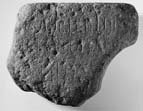
Object type: Part of cross-arm [1]
Measurements: L. 15.6 cm (6.1 in) W. 19.8 cm (7.8 in) D. 8.3 cm (3.2 in)
Stone type: Fine-grained micaceous deltaic sandstone containing feldspar. This well sorted rock has been extensively burnt so as to crack the rock. The original colour (very pale brown, 10YR 7/4) has been oxidised by burning to a light red colour (2.5YR 6/6) in many places. Stone provenance as Whitby 1 (abbey, St Peter and St Hilda)
Plate numbers in printed volume: Ills. 973–7
Corpus volume reference: Vol 6 p. 244-245
(There may be more views or larger images available for this item. Click on the thumbnail image to view.)
A wide circular arm-pit remains; the profile of the surviving tip indicates that it was type A10.
A (broad) : Plain with a worn inscription.
Inscription Whitby 22 preserves traces of three lines of lightly incised and very weathered lettering on what appears to have been the upper arm of the cross, to judge from the alignment of the lettering. The letters, which were roughly 2 cm in height, seem to have been mixed capitals, although none of them can now be read with complete certainty.
The lettering appears to have been laid out neatly and to have combined rounded and angular forms. The following points may be made about the damaged characters for which readings are suggested above. The 'V' consists of two rounded strokes meeting at an angle at the base. The remaining part of the 'G' is a letter like a round C finished at the bottom right with a short vertical descending stroke. This resembles the uncial-derived G to be seen, for example, in the display script of the Barberini Gospels and the Cuthbercht Gospels, both of the second half of the eighth century (Alexander 1978, ills. 178 and 183). A short linear serif marks the end of the vertical. The first 'C' is angular and is shorter than the other letters. The next 'C' has a straight back but a rounded base and seems to have terminated at the bottom right in a linear serif. (This letter may alternatively have been an E, or possibly an L.) If the 'C' in the next line is correctly read, it was the angular form. These letters seem to have been narrow and compressed in their proportions. Enough of the lettering remains to disprove Radford's suggestion that the inscription was in runes (Peers and Radford 1943, 37; Page, R. 1995, 171–2). The language and meaning are, however, irrecoverable.
B (narrow) and E (end) : Plain and slightly chamfered, with an incised edge moulding adjacent to face A.
C (broad) : Plain.
D (narrow) : Broken.
The edge mouldings on the narrow faces relate this to the more elaborate examples in the Plain Cross group. See also Whitby 30 (Ills. 1012–15).
Inscription Whitby 22 seems to be a fragment of a plain stone cross with an inscribed head that can be compared to Whitby 20, 21 and 23 and perhaps also 24 and 26. [2] The inscription starts surprisingly close to the top edge of what seems to have been the top arm and would have been unusually long if, as is possible, it continued into the centre of the head and the other arms.
The mixed capitals that seem to have been used in this inscription seem to have been of the sort that could be classified under the same broad label of 'Insular decorative capitals' as Whitby 47 and 48, and perhaps also Whitby 23 (Higgitt 1994). The lightness of incision is a characteristic shared with Whitby 48 (Ill. 1066).
[1] The following are general references to the Whitby stones: Hood 1927, 38, 45, 49; Kendall 1932, 9–10, 26–7, 28; Peers and Radford 1943, 33–40; Clapham 1952, 11; Wilson, D. 1964, 9; Cramp 1965b, 4; Fellows-Jensen 1972, 218; Cramp 1976a, 228; Cramp 1976b, 455–7; Rahtz 1976, 460; Cramp 1978a, 7; Bailey 1980, 81, 82; Okasha 1983, 118; Cramp 1984, 9, 79, 109, 180, 222; Higgitt 1986b, 130–1, 134, 148; Bailey and Cramp 1988, 55, 56, 85, 154; Cramp 1989, 223; Lang 1989a, 67; Lang 1990a, 2–3; Higgitt 1991, 45; Lang 1991, 24, 109, 138, 139; Cramp 1992, 8, 24, 107, 224, 252; Okasha 1992, 84; Cramp 1993, 68–9, 71; Fellows-Jensen 1995, 177; Higgitt 1995, 229–36; Rahtz 1995, 7–8; Bailey 1996a, 50–1, 111; Hawkes 1999b, 403, 410–16; Karkov 1999, 133–4; Stocker 2000, 200; Stopford 2000, 102, 104.
[2] See discussion of Whitby 20 (p. 242).
