Select a site alphabetically from the choices shown in the box below. Alternatively, browse sculptural examples using the Forward/Back buttons.
Chapters for this volume, along with copies of original in-text images, are available here.


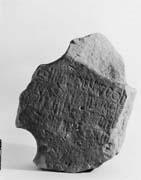
Object type: Part of cross-head [1]
Measurements: H. 50.8 cm (20 in) W. 39.6 cm (15.6 in) D. 16 > 15.2 cm (6.3 > 6 in)
Stone type: Medium-grained deltaic sandstone with angular feldspar grains. Bedding planes seen parallel to the lettered face. Very pale brown (10YR 7/4). Stone provenance probably as Whitby 1 (abbey, St Peter and St Hilda)
Plate numbers in printed volume: Ills. 978–81
Corpus volume reference: Vol 6 p. 245-246
(There may be more views or larger images available for this item. Click on the thumbnail image to view.)
A (broad) : Four semicircular arm-pits survive but no limbs. On the left are remains of a narrow edge moulding. A worn inscription fills the face of the cross-head.
Inscription Traces of four lines of incised lettering run across the full remaining breadth of the cross-head. It is uncertain how far the lines extended onto the lost sections of the horizontal arms. The blank area above the top line shows that this was always the first line and there are no certain indications of lettering below the fourth line. Letters were generally about 3 cm high, although the vertical of the last remaining letter in line 1 projects above and below the line and reaches about 4.5 cm. The inscription is so badly abraded that few letters are now recognizable and language and meaning are uncertain.
The inscription seems to have been in capitals and to have included some uncial forms. The first distinct form in line 1 may perhaps have been intended as a version of uncial A in which the diagonal stroke has been set vertically. If so, it can be paralleled in the display script of the Lindisfarne Gospels, although there the loop is angular rather than rounded (e.g. the last letter on fol. 95r: Alexander 1978, ill. 46). The next letter might have been B or uncial H. The third line from the right in line 1 seems to have been a rounded, or uncial, E and the last remaining letter could have been an uncial H, although it was more probably a thorn and therefore probably part of an Old English name. The penultimate letter in line 2 may have been capital A with an angled cross-bar.
B (narrow) : The arm-pits are roughly dressed but worn; plain.
C (broad) : Smoothly dressed, and plain.
D (narrow) : As face B.
One of the plain crosses without edge mouldings which seem to belong to a later development of the Plain Cross series (see Chapter VI).
Inscription Whitby 23 seems to have been a plain stone cross designed to display an inscription on its head and, as such, can be compared to Whitby 20, 21 and 22, and perhaps also 24 and 26.[2] The inscription on this cross was comparatively long and was set out in four packed lines of lettering. The contents and purpose of the inscription are unknown but, if it contained an Old English name as suggested by the possible thorn, that would suggest that it was a memorial to a named individual. Radford's reading of the first line as a part of a Latin memorial formula cannot be justified on the basis of what survives on the stone (Peers and Radford 1943, 46).
The lettering seems to have consisted of capitals of mixed forms and could perhaps be classed with the 'Insular decorative capitals' found in the display script of many Insular manuscripts and some Insular inscriptions (Higgitt 1994). The lettering of Whitby 23, as far as it can now be judged, seems to have been somewhat different in character from the plain capital and uncial forms of Whitby 20 and 21 and may represent a different, perhaps somewhat later phase, in which a greater variety of forms was admitted into display script and inscriptions at Whitby, although these letters seem to have lacked the angularity of treatment that can be glimpsed in Whitby 22 and 34.
