Select a site alphabetically from the choices shown in the box below. Alternatively, browse sculptural examples using the Forward/Back buttons.
Chapters for this volume, along with copies of original in-text images, are available here.


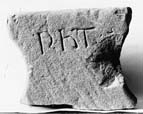
Object type: Cross-arm [1]
Measurements: L. 19.4 cm (7.6 in) W. 23.8 cm (9.4 in) D. 8.5 cm (3.3 in)
Stone type: Fine-grained micaceous deltaic sandstone with sub-angular well sorted grains; bedding parallel to lettered face. Pale brown (10YR 6/3). Stone provenance as Whitby 20 (abbey, St Peter and St Hilda)
Plate numbers in printed volume: Ills. 982–7
Corpus volume reference: Vol 6 p. 246-247
(There may be more views or larger images available for this item. Click on the thumbnail image to view.)
Cross-arm, very short with wide curved arm-pits, type 10 A or B.
A (broad) : Smoothly dressed. There is a slight chamfer on the arm-pit edge.
Inscription There are three boldly incised letters near the end of one of the broad faces of this cross-arm. The letters are 3.5–4 cm in height.
This is not as it stands meaningful but the group of letters could have formed part of an Old English name of which beorht formed either the first or second element ( Beorht- or –beorht). If this is right, it is possible that other letters of the name appeared at the ends of other arms. Alternatively, this may have been a trial or practice piece onto which a familiar but meaningless group of letters was cut, in which case the stone was perhaps already fragmentary.
The lettering is well cut with careful variations in the depth of cutting, although the layout and alignment are a little informal. The verticals are not completely perpendicular to what seems to have been the original end of this arm of the cross. The letter-forms are mixed. The R is a variant of the capital (or uncial) form with a large and unusually open bowl and a short right foot. The H seems to derive from the Insular half-uncial letter, in which the lower part of the right-hand stroke is vertical, rather than from the uncial, where it curves back to the left. The T is the plain capital (or uncial) letter.
B and D (narrow) : Smoothly dressed arm-pit.
C (broad) : Plain and smoothly dressed. The arm-pit is chamfered.
E (upper) : As face C.
These plain cross-heads which are so characteristic of Whitby may have been mass-produced and lettered afterwards, as the rather random inscription implies.
Inscription If these three letters formed part of a personal name, the rest of which was elsewhere on the cross-head, Whitby 24 would seem to have been another plain stone memorial cross with an inscribed head that could be compared to Whitby 20, 21, 22, 23 and perhaps also Whitby 26. [2] The splitting of a name across the ends of three or four arms of a cross seems to be without parallel on any of the surviving free-standing stone crosses in the British Isles, but it can be seen on the equal-armed cross within a circle carved in false relief on an eighth- or ninth-century grave-marker at Hexham (Okasha 1971, 80, pl. 52; Cramp 1984, 181–2, pl. 178, 952). It is, however, possible that this was a trial piece and that the inscription was meaningless.
This small sample of mixed lettering combines capital forms with one apparently derived from Insular half-uncial, but the forms are not sufficiently diagnostic to suggest anything more precise than a broad dating to the eighth or ninth century. It is not clear why Peers and Radford (1943, 37) suggested that the lettering was 'probably medieval', that is post-Conquest.
[1] The following are general references to the Whitby stones: Hood 1927, 38, 45, 49; Kendall 1932, 9–10, 26–7, 28; Peers and Radford 1943, 33–40; Clapham 1952, 11; Wilson, D. 1964, 9; Cramp 1965b, 4; Fellows-Jensen 1972, 218; Cramp 1976a, 228; Cramp 1976b, 455–7; Rahtz 1976, 460; Cramp 1978a, 7; Bailey 1980, 81, 82; Okasha 1983, 118; Cramp 1984, 9, 79, 109, 180, 222; Higgitt 1986b, 130–1, 134, 148; Bailey and Cramp 1988, 55, 56, 85, 154; Cramp 1989, 223; Lang 1989a, 67; Lang 1990a, 2–3; Higgitt 1991, 45; Lang 1991, 24, 109, 138, 139; Cramp 1992, 8, 24, 107, 224, 252; Okasha 1992, 84; Cramp 1993, 68–9, 71; Fellows-Jensen 1995, 177; Higgitt 1995, 229–36; Rahtz 1995, 7–8; Bailey 1996a, 50–1, 111; Hawkes 1999b, 403, 410–16; Karkov 1999, 133–4; Stocker 2000, 200; Stopford 2000, 102, 104.
[2] See discussion of Whitby 20 (p. 242).
