Select a site alphabetically from the choices shown in the box below. Alternatively, browse sculptural examples using the Forward/Back buttons.
Chapters for this volume, along with copies of original in-text images, are available here.


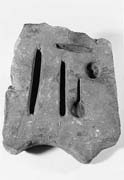
Object type: Cross-arm reused as mould [1]
Measurements: L. c. 16 cm (6.3 in) W. c. 19.5 cm (7.7 in) D. 7.5 cm (3 in)
Stone type: Unobtainable
Plate numbers in printed volume: Ill. 1019–20
Corpus volume reference: Vol 6 p. 250
(There may be more views or larger images available for this item. Click on the thumbnail image to view.)
The shape of one edge of this piece indicates that it was a plain cross-arm, type D9, reused as a mould with three incisions, one rectangular, one circular and one spoon-shaped.
The long rectangular shapes are plausibly for ingots, the round shape possibly for a stud, and the spoon shape possibly for an ornament. The ingots would be consonant with a Viking-age date (David Wilson, pers. comm.), and this piece is an important indication of activity on the site at that period.[2]
[1] The following are general references to the Whitby stones: Hood 1927, 38, 45, 49; Kendall 1932, 9–10, 26–7, 28; Peers and Radford 1943, 33–40; Clapham 1952, 11; Wilson, D. 1964, 9; Cramp 1965b, 4; Fellows-Jensen 1972, 218; Cramp 1976a, 228; Cramp 1976b, 455–7; Rahtz 1976, 460; Cramp 1978a, 7; Bailey 1980, 81, 82; Okasha 1983, 118; Cramp 1984, 9, 79, 109, 180, 222; Higgitt 1986b, 130–1, 134, 148; Bailey and Cramp 1988, 55, 56, 85, 154; Cramp 1989, 223; Lang 1989a, 67; Lang 1990a, 2–3; Higgitt 1991, 45; Lang 1991, 24, 109, 138, 139; Cramp 1992, 8, 24, 107, 224, 252; Okasha 1992, 84; Cramp 1993, 68–9, 71; Fellows-Jensen 1995, 177; Higgitt 1995, 229–36; Rahtz 1995, 7–8; Bailey 1996a, 50–1, 111; Hawkes 1999b, 403, 410–16; Karkov 1999, 133–4; Stocker 2000, 200; Stopford 2000, 102, 104.
[2] A second mould from the Whitby excavations (EH 81430751), which has been illustrated in several publications on Viking-age archaeology (Foote and Wilson 1970, pl. 1b; Wilson, D. 1976b, 395; Graham-Cam
