Select a site alphabetically from the choices shown in the box below. Alternatively, browse sculptural examples using the Forward/Back buttons.
Chapters for this volume, along with copies of original in-text images, are available here.


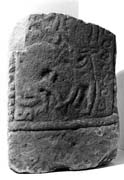
Object type: Lower part of cross-shaft [1]
Measurements: H. 39.4 cm (15.5 in) W. 28.7 cm (11.3 in) D. 11.3 cm (4.4 in)
Stone type: Fine-grained, well sorted feldspathic sandstone with sub-angular grains. Very pale brown (10YR 7/4). Stone provenance as Whitby 1 (abbey, St Peter and St Hilda)
Plate numbers in printed volume: Ills. 1026–9
Corpus volume reference: Vol 6 p. 251
(There may be more views or larger images available for this item. Click on the thumbnail image to view.)
A (broad) : There are remains of a cabled edge moulding on this shaft of slab-like proportions. At the right-hand side within the moulding is a vertical run of small scrolls. Most of the panel is occupied by a profile quadruped animal with gangly legs and its tail knotted through its hind quarters. The rump is held high and the torso is an S-formation. Around the neck is a fetter band and above the rump are worn looping strands. In the lower left-hand corner is a simple twist filler. The lower part of the stone has a transverse modelled moulding in picked work, below which there is no carving.
B and D (narrow) and C (broad) : Axe dressed on three faces.
The flat profile of the animal and its posture are reminiscent of those on Lythe 1 and 19 (Ills. 463, 533), though this is by a less accomplished hand. The fettering is an Anglo-Scandinavian feature. The proportions of this shaft are noticeably distinct from those of the Plain Cross series at Whitby. Radford offers a choice of interpretations of the shape of the animal.
