Select a site alphabetically from the choices shown in the box below. Alternatively, browse sculptural examples using the Forward/Back buttons.
Chapters for this volume, along with copies of original in-text images, are available here.


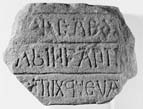
Object type: Fragment of architectural panel [1]
Measurements: H. 15.3 cm (6 in) W. 21.4 cm (8.4 in) D. 6.1 cm (2.4 in)
Stone type: See Whitby 20 (abbey, St Peter and St Hilda); stone provenance as Whitby 21 (abbey, St Peter and St Hilda)
Plate numbers in printed volume: Ills. 1061–4
Corpus volume reference: Vol 6 p. 258-259
(There may be more views or larger images available for this item. Click on the thumbnail image to view.)
A (broad) : Only the straight upper edge is original. The surviving part of the face is smoothly dressed and carries the remains of an inscription.
Inscription The inscription now consists of three incomplete lines of incised lettering neatly laid out and separated by deeply incised guide-lines. Since the upper edge of the stone survives in part, the top line of the inscription is the original first line. The stone is broken at the bottom and so it is uncertain whether further lines of text have been lost below. The average letter height is about 2.5 cm. The remaining letters may be transcribed as follows:
As both the left and right edges of the panel are damaged, an unknown quantity of text has been lost on either side of what remains. Lines 2 and 3 were clearly in Latin and line 2 may plausibly be reconstructed as — AB INFANTI[A] — (`... from infancy ...'). The third line opens with a feminine noun ending in –trix. The next syllable is either the enclitic particle –que or the nominative feminine relative pronoun quae. Line 3 can therefore be reconstructed either as — [—]TRIXQVE VA[—] — or as — [—]TRIX QVE VA[—] — (`... and —trix ...' or `—trix who ...'). If the former reconstruction is correct, the noun ending in –trix would have been the second of two nouns. Spaces do not seem to have been used to separate words in lines 2 and 3 and so it is not clear where the division came between the remaining letters of line 1. The inscription may have commemorated a woman (–trix) who had been a member of the monastic community at Whitby since she was a little girl (ab infantia). The first line may have included her name and Æd- might perhaps have formed part of an Old English name of the /Æthel- type, although what is left of the letter following the D does not look like E or I. It is therefore more probable that -Æd- represents the name-element Ēad-. When Ēad- was combined with a second element that either had a stressed vowel in -i- (Campbell 1959, § 200), or in -y- (Campbell 1959, § 204(2)), then i-mutation could result, giving early Northumbrian Æd-, or later Ēd-. Possible feminine second elements include the common -þrȳð, -gȳð, -gifu, -hild, and -swīð.[1]
The lettering consists of mixed capitals and includes some distinctive letter forms drawn from Insular half-uncial. The four As seem all to have been the decorative variant of the capital with a head-bar and a broken cross-bar, a form found elsewhere in Insular inscriptions and display script (A5 in Higgitt 1994, 219, 224). The letter that preceded the T in line 3 must have been a vowel and the remaining curved stroke is most likely to have been the upper 'horn' of the `oc' A of Insular half-uncial, giving a word terminating in –atrix. Alternatively the curved stroke could be part of round E or perhaps C, in which case the word would have ended in –etrix (genetrix?) or –ctrix (possibly doctrix, a term applied by Bede to Ælfflæd (Bede 1969, 430–1, iv .26). The B in line 2 has the distinctive sinuous back of the Insular half-uncial letter. The open bowl is unusual in the text script but can be seen on Wensley 9 (Ills. 884, 886) and, in a straight-backed version of the letter, on Whitby 49 (Ill. 1068). The D in line 1 is an angular and open-bowled variation on the uncial letter, which is also one of the forms used in Insular half-uncial. The same form appears in an inscription on a fragmentary Pictish cross from Lethnot in Angus that has been dated on art historical grounds to 'well into the ninth century' (Okasha 1985, 53–4, 57, pl. III). The round E in line 3 has its cross-bar set nearer to the top than the bottom and resembles the display letter based on Insular half-uncial that is used, for example, in the Lindisfarne Gospels (Alexander 1978, ills. 40, 45). The third extant letter of line 1 and, very probably, the first look like straight-backed versions of the same rounded E. The F in line 2 has the distinctive, slightly arched upper horizontal of the Insular half-uncial letter. Similar forms can sometimes be found in Insular display script and inscriptions, for example on Wensley 8 (F1 in Higgitt 1994, 219, 226). The Ns in line 2 have the low-slung and shallow diagonal of the Insular half-uncial letter (ibid., 220, 228). The Q in line 3 is explicable as the Insular half-uncial letter with an extended descender and reduced bowl. As on Whitby 49 (Ill. 1068), the bowl of the R has been left wide open at the base. The Ts are narrow versions of the capital (T1 in ibid., 220, 231). V is a narrow leftward-leaning version of the capital. X is the straight-lined capital. Details of cutting are now rather worn but the letter-cutter seems to have thickened the terminals of strokes in imitation of the wedged serifs of the text and display scripts of Insular manuscripts. The mixed capitals of Whitby 47 can be classed in the tradition of Insular decorative capitals that flourished in manuscript display script and inscriptions in the eighth and early ninth centuries (Higgitt 1994).
B and D (narrow) and F (bottom) : Broken.
C (broad) : Uneven but probably original.
E (top) : Flat and smoothly dressed.
Inscription Whitby 47 is part of an inscribed panel that was perhaps set into the wall of a stone building. The text of the inscription is too fragmentary for its purpose to be certain. A woman, the —trix of line 3, seems to have been the subject of a now missing verb. She had perhaps been a member of the community at Whitby since infancy. Most probably the inscription was an epitaph but this cannot be confirmed from the surviving wording. If this inscription marked a burial within a church at Whitby, the person commemorated must have been a person of high status. We know from the anonymous Life of Gregory the Great that was composed at Whitby that there were a number of royal burials in the church of St Peter at Whitby (Colgrave 1968, 104–5).
It has been suggested above that the first line contained an Old English name starting with &ælig;d-. Radford (Peers and Radford 1943, 42 and fig. 4) reconstructed this first line as containing a better known Old English name: '+ AEL]FLEAEDA'. There are two difficulties with this. Firstly, the restoration of the two badly damaged letters as FL is hard to reconcile with what remains on the stone. Secondly, the letter sequence –eae- is unlikely in Old English and, furthermore, at Whitby one might expect the name to have appeared in the Anglian form Ælfflēd (Boehler 1930, 157–8, 15–17, 26–8; Ström 1939, 158).[3] While it is not impossible that this inscription commemorated, as Radford suggested, the Ælfflæd, who was offered by her father King Oswiu at the age of one to a life of perpetual virginity and ended her days as abbess of Whitby, dying there in about 714, there is no evidence that her name appeared in this inscription (Bede 1969, 290–3, iii.24; Fell 1981, 84). The phrase ab infantia need not refer to Ælfflæd: it is unlikely that she was the only female member of the community at Whitby to have been dedicated to a monastic life in infancy. The phrase may have been a biblical reminiscence, being used for example in contexts implying piety from infancy in Tobias 1.10 and Job 38.1. The third line may have described the commemoratee in eulogistic terms. Radford cited a phrase used by Stephen in his Life of St Wilfrid to describe Ælfflæd, 'semper totius provinciae consolatrix optimaque consiliatrix', that shows the sort of language that was thought appropriate to commemorate a prominent nun (Peers and Radford 1943, 42; Colgrave 1927, 128).
As has been seen, there is no compelling reason for associating this inscription with Ælfflæd and so the text does not date the inscription. The decorative capitals of the inscription point to a date in the eighth or early ninth century. Deeply incised guide-lines of the sort seen on this stone seem to have been very rare in England before the ninth century (Higgitt 1991, 46–7; id. 1995, 233). Taking the evidence of the guide-lines and the lettering together, the inscription can perhaps be dated to some time around the later eighth or earlier ninth century.
[1] The following are general references to the Whitby stones: Hood 1927, 38, 45, 49; Kendall 1932, 9–10, 26–7, 28; Peers and Radford 1943, 33–40; Clapham 1952, 11; Wilson, D. 1964, 9; Cramp 1965b, 4; Fellows-Jensen 1972, 218; Cramp 1976a, 228; Cramp 1976b, 455–7; Rahtz 1976, 460; Cramp 1978a, 7; Bailey 1980, 81, 82; Okasha 1983, 118; Cramp 1984, 9, 79, 109, 180, 222; Higgitt 1986b, 130–1, 134, 148; Bailey and Cramp 1988, 55, 56, 85, 154; Cramp 1989, 223; Lang 1989a, 67; Lang 1990a, 2–3; Higgitt 1991, 45; Lang 1991, 24, 109, 138, 139; Cramp 1992, 8, 24, 107, 224, 252; Okasha 1992, 84; Cramp 1993, 68–9, 71; Fellows-Jensen 1995, 177; Higgitt 1995, 229–36; Rahtz 1995, 7–8; Bailey 1996a, 50–1, 111; Hawkes 1999b, 403, 410–16; Karkov 1999, 133–4; Stocker 2000, 200; Stopford 2000, 102, 104.
[2] I am very grateful to David Parsons for contributing the last two sentences discussing this possible name-element.
[3] I am very grateful to David Parsons for his advice on the linguistic problems
