Select a site alphabetically from the choices shown in the box below. Alternatively, browse sculptural examples using the Forward/Back buttons.
Chapters for this volume, along with copies of original in-text images, are available here.


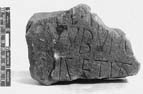
Object type: Fragment [1]
Measurements: H. 10.3 cm (4.1 in) W. 15.7 cm (6.2 in) D. 4.7 cm (1.8 in)
Stone type: As Whitby 34 (abbey, St Peter and St Hilda) (indeed could this be a fragment of no. 34?)
Plate numbers in printed volume: Ills. 1065–6
Corpus volume reference: Vol 6 p. 259-261
(There may be more views or larger images available for this item. Click on the thumbnail image to view.)
A (broad) : Broken on all edges. The surface is smoothly dressed.
Inscription The only partially intact face of this stone carries two fragmentary lines of lightly incised lettering. An even more lightly incised horizontal line runs above the upper line of lettering and may originally have been part of a frame around an inscribed panel. The remains of incised verticals above the horizontal perhaps survive from some decorative or other feature rather than lettering. The lines of lettering were neatly laid out and the letters are about 3 cm in height. What remains may be transcribed as follows:
An uncertain amount of text has been lost at the beginning and end of each line. The BVR of the first line may be part of the name element Burg- or –burg, which was used either as the first or the second element of many Old English feminine personal names as well as the first element of some masculine names (Searle 1897, 120–2; Boehler 1930, 136–8; Ström 1939, 10, 162). The fragmentary rounded letter following the R could well have been uncial or capital G. A deliberate space seems to have been left between the S and the E of the second line. A word-division at this point suggests that the text was in Latin and that a word ending in –is was followed by the word etiam ('also', 'and also', 'indeed', 'again' etc.) A Latin inscription with a personal name in the first line is likely in this context to have been an epitaph. The inscription may have continued into one or more further lines below the second line.
The lettering is an example of Insular decorative capitals. The line is fine and the letters are slender. The first clear letter in line 1 is angular V in the form in which the diagonals intersect a little above the base and the resultant angle is closed by a short horizontal stroke at the base. This form can be seen in display script in the Insular tradition in manuscripts of the eighth and ninth centuries, including Durham Cathedral MS A.II.17, the Lichfield Gospels and the Book of Mulling, and in an inscription in Insular decorative capitals found on Ramsey Island (Higgitt 1994, 232; Okasha 1970, pl. XVII). The second V in line 1 was almost certainly of the same type. The damaged first letter of the line may also have been of the same form, to judge by the ghosts of diagonals that can still be made out. The B is a forward-sloping, open-bowled version of the capital. The R is again the capital form but it is too worn to be certain whether the bowl was left open as in the Rs of Whitby 24, 47 and 49. The damaged letter at the end of line 1 could have been rounded capital or uncial G. Decorative capital versions can be seen, for example, in the display script of the Lindisfarne Gospels (Alexander 1978, ills. 28–31, 39, 44, 46). Other possibilities include round C or O. The S is the angular reversed-Z version of the capital, which is a common form in Anglo-Saxon inscriptions and in the display script of Insular manuscripts such as the Lindisfarne Gospels (S2 in Okasha 1964–8; Alexander 1978, ills. 28–30, 37, 41, 44–6, 109, 139, 160, 170, 176, 261, 312–5). The E and T seem to have been the normal capitals. The A was the decorative form of the capital with a horizontal head-bar and an angular cross-bar, a form found in Insular display script and inscriptions including Whitby 47 and Wensley 9 (A5 in Higgitt 1994, 219, 224). Light serifs resembling the wedged serifs of Insular scripts can be seen on most of the terminals.
B–F: Broken.
Inscription Radford may have been right to identify this piece as a fragment of a panel inscribed for display in a wall (Peers and Radford 1943, 41). However, since the maximum dimension is now 15.2 cm and nothing remains of the other faces, it is possible that it comes from a cross or some other type of monument. Whatever the original form of the stone on which the inscription was displayed, the probable appearance of a personal name near the beginning suggests that the inscription was funerary in purpose. The Insular decorative capitals of the inscription are of a sort that was current during the eighth and earlier ninth century.
